

Introduction
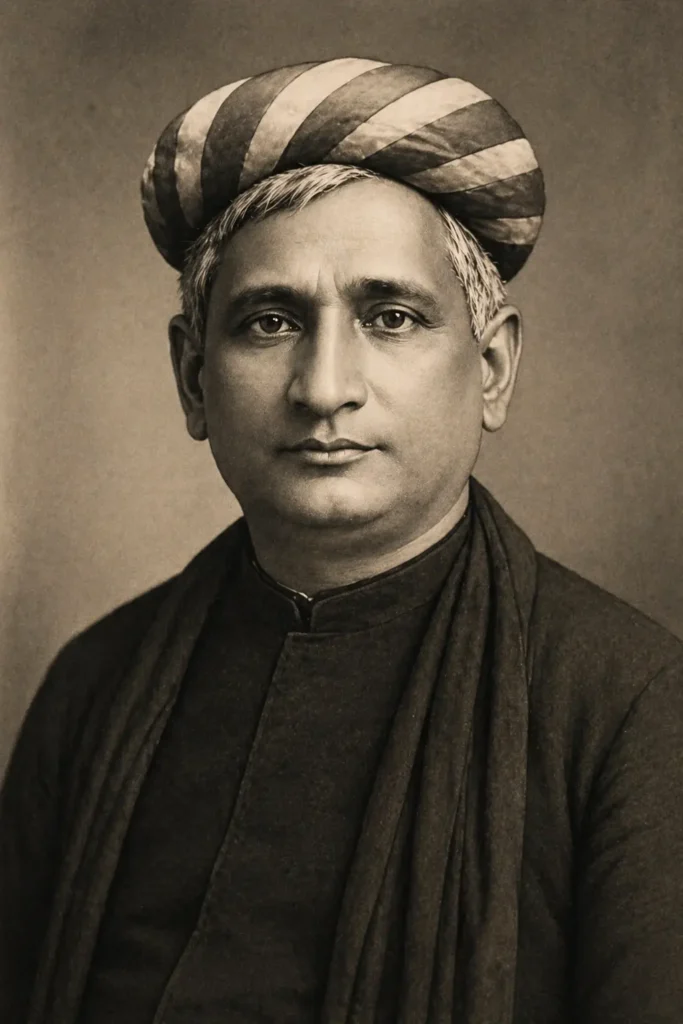
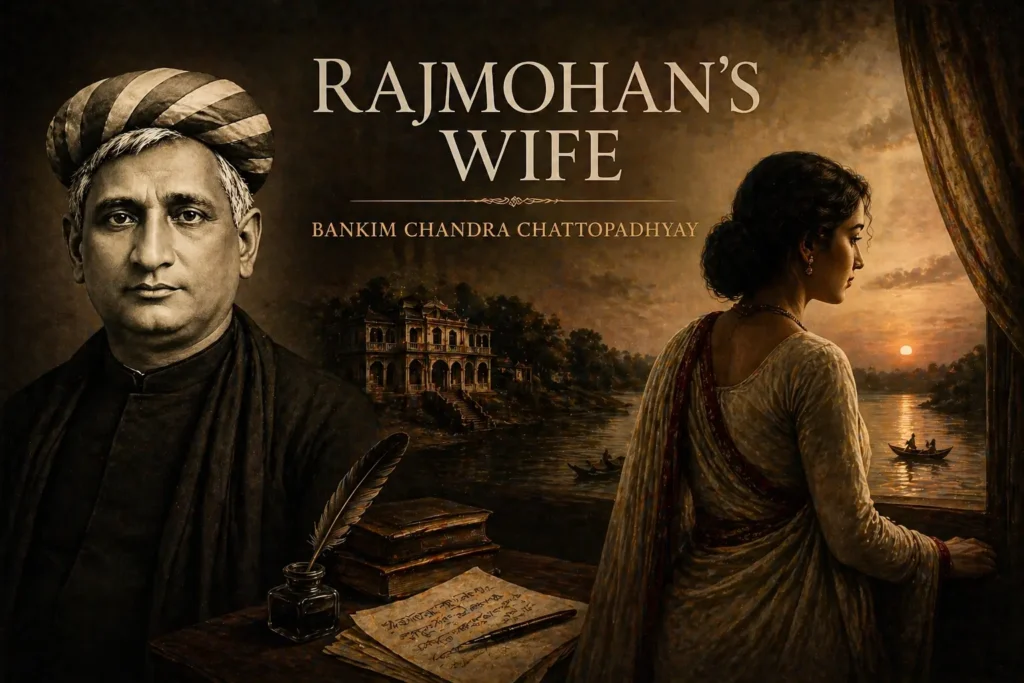
Bankim Chandra Chattopadhyay’s Rajmohan’s Wife is the product of an age when a new India was emerging from new ideologies. It was the time of Bengal’s ‘Literary Renaissance’. The debut novel of the writer, the very first Indian English novel as well as the first Indian novel ever written, Rajmohan’s Wife by Bankim Chandra Chattopadhyay plays a very significant role as a terminus a quo in the history of Indian Literature.
As in the murky beginnings of any genre, the commencement of Indian English fiction too is shrouded in mystery[[1]]. After a century of being overshadowed by oblivion, Rajmohan’s Wife as we know it today is not entirely the book that Bankim wrote, but is a reprint of a reconstruction that Brajendra Nath Banerji published in 1935.
This historic novel was initially published in the weekly periodical the Indian Field as a serial in 1864, edited by Kishori Chand Mitra. After which it was forgotten, until found perchance owing to the mistake of a binder, with the volumes of Hindoo Patriot. All but the first three chapters were recovered so Banerji used Bankim’s Bangla translation of this work to translate it back to English hence completing the masterpiece as a whole, which was then published in the form of a novel. So this novel stands at an intersection of being an original novel as well as a translated version.
Rajmohan’s Wife as Bankim’s first and last English novel:
After the revolt of 1857, British rule was an accepted reality, and gradually they were trying to create a class who would be Indians in colour and blood, but English in taste, in opinions and morals. There was a class of people who were educated and believed English education was good for character development with the ongoing chaos of social evils in the Indian society. And this group of educated population was the target audience for Bankim’s first novel.
English was a privilege to only the upper class[[2]] and with the lack of practice of educating women, Bankim was sure his audience would comprise only of educated men, which accounted of the usage of pronouns ‘him’ and ‘he’ by Bankim while referring to his readers in the book. This piece of literature stands on the threshold between romanticism and realism and also has both the traditional as well as modern aspects; hence Bankim wrote his first socio-literary contribution in the language he could express himself best in.[[3]]
Mukherjee argues that “though Bankim accepted English as a valid medium for political and polemical writings, the mother tongue was the preferred language of imaginative literature.” ( Mukherjee, 151), hence his first English novel also happens to be his last as critic Makarand R. Paranjape comments, “The kind of Indian experience that can be represented in English is different from what is available in other Indian languages. That Bankim was well aware of these limitations is obvious; therefore his switching to Bangla was not just accidental or fortuitous, but deliberate and felicitous both aesthetically and politically.”
Language of the novel
“The very special brand of Bankim prose with its resonance and its decorative, intricate and subtle nuances and their lingering exuberance is created for the first time by Bankim in his Rajmohan’s Wife” (Sreenivasan, 205)
This piece of writing was a contemporary to numerous brilliant classics belonging to the Victorian Age of British Literature. Bankim’s novels show the influence of Shakespeare, Scott and the Romantic poets as well as Sanskrit Kayva tradition. In the first three chapters translated by Brajendra Nath Bannerjee he seems to go too literal with his translation, while using lines like, “hang you monkey” and “ go to Jericho” while Bankim did not go this rigid with his English writing, he included several Benagli terms like “dada” “masi” “danda” “ lathhis” “darwans”, “Thakur-thakurani”, and a few commonly used Urdu and Persian terms belonging to the age like “zaruri” “wasihat’ “vakaltnama” and Bengali phrases like “ma gow” “raju da” “gola handi” etc.
At many instances Bankim uses the more familiar Hindustani terms like “zanana” instead of the Bengali synonym or rigid English translation. There are uses of profound translations of Bengali idioms in English like “even the salagram dies”, “no snatching of a childs sweetmeal” or “he takes the straw between his teeth” Many a times Bankim uses both the English and the Bengali terms of certain words like “masi-aunty”, “dada-cousin”, “supari\bakul-aceranut” etc. Paranjape says “Bankim had the anxiety of tailoring his sensibility to suit the cloth of English idioms and metaphors, to suit his readers’ preferences.”
Shakespearean influence on Bankim is much evident and is highlighted when he uses phrases like “for heaven’s sake, descend from my bosom” or “ I swear you by my patron god” or Rajmohan’s famous tirade in Old English when he accuses Matangini:
‘Woman,’ he said fiercely, ‘deceive me not. Canst thou? Thou little knowst how I have watched thee; how from the earliest day that thy beauty became thy curse, I have followed every footstep of thine – caught every look that shot from thine eyes. Brute thou I be,’ continued he again becoming gentle, ‘I was proud of my beautiful wife … Did I not see before thou wert a woman, thou didst already become fond of that cursed wretch? Did I not see how time ripened thy fondness into sin? ‘(Chatterjee, 60). Here Meenakshi Mukherjee sees echoes of Othello like speech.
The Indian Theme:
Rajmohan’s Wife as Mukherjee says is, “a potent site for discussing crucial questions about language, culture, colonization, and representation.” Set amidst the backdrop of the typical Bengali society of the 19th century(colonized India), patriarchal order and feudalism, Rajmohan’s Wife gives a mirror reflection of the then society. From the ‘Hindu inheritance law to the Kulin Brahmin’s numerous marriages, from Matangini’s commitment towards her husband as traditional ethical laws to Matangini’s fruitless transgressive love story, from the tropical Indian East Bengal scenes to the Indian language, every aspect reflect the India of Bankim’s time.
Most of the characters belong to the bourgeoisie upper class. Usage of names of Indian gods and goddess like ‘Vishwa Karma’ and ‘Durga’, and terms like “half a danda” and “agdum bagdum” enrich the Indianess of the story. Fashion related mentions include the ‘Dacca cotton’ used for dhoti, chudder as turban and the English shoes used by Mathur. Also couch shells, churis and vermillion, the Indian accessories.
Also, the brief mention of East Bengal and West Bengal rivalry in the terms of elegance and proprietary of hairstyles with the mentions of “khompa” and “binumi”. The nocturnal journey of Matangini to warn Madhav, can be compared to Radha’s, to meet her lover Krishna, in Vaishnav literature[[4]] , ironically Matangini’s was not a romantic journey to meet her lover. The account of Matangini’s midnight excursing was influenced clearly by the abhisarika figure of Sanskrit love poetry.
The Englishness of the novel:
Bankim also doesn’t fail to confer to Englishness in the play, with the mentions of salads(which were not even a part of Bengali food), Billingsgate, and the picture of ‘The Virgin and the Child’ along with the portraits of Durga and Kali, in a typical non-westernized rural family in Bengal and the mention of ‘Anglo on tinting of Guido’ is in reference to cultural frame of the English educated readers.
The description of the dungeon in a cellar, the splendor of décor seems unexpected in crude dungeon , but the gorgeous setting and the pale beauty on the mahogany bed, still un- ravished though emaciated through starvation recreate motifs of late 13th century gothic fiction in Britain.
The Females of the Tale:
“Thus armed, a formidable champion of the world-conquering sex set out with a pitcher in her arm and pushing open the wattled gate of a neighbouring house entered within it.” (Chatterjee, 1)
Rajmohan’s Wife, is not only the first noel but also one of the first novels to realistically represent women in the nineteenth century. Set in a newly emerging society of India, it provides an insight into the status of women, their susceptibility and dependence on men. It is noticeable that Bankim Chandra followed the style and pattern of Victorian age literature. He gave his female characters a unique distinction especially to the heroines. Matangi is braver than the hero Madhav, himself.
She confessed her love for her sister’s husband; after taking a solitary journey in the dark night through forest, water, storm and lightning, surely women are more courageous and determined in Bankim Chandra’s novel than men, echoing the name of the 20th chapter of the novel “Some Women Are The Equals Of Some Men”. Matangini’s commitment to her husband is not to be violated as a virtue of Bankim Chandra’s heroin.
Like Shakespeare’s novels, Bankim Chandra’s heroines are crucially important, female protagonist with immense beauty and brain, courageous and ethical, moral and loyal. Yet what is untypical is that these beautiful and intelligent heroines do not have a fairy tale like ending, no union with their lovers contrary to Shakespeare’s “Journeys end in lovers meeting.” (Shakespeare, 2.3.52)
Rajmohan’s Wife – A Social Novel:
Social novels show the true image of the ordinary people’s mindset, situation, problems of life, social evils, ethics, rituals, superstitions etc. Rajmohan’s Wife is a melodramatic player based on simple black and white contrasts. Bankim paints his characters as simply black and white, no greys. Madhav and Matangini are pure and good characters while Mathur and Rajmohan are bad. Instances of Rajmohan’s evils are portrayed beforehand, like him abusing Matangini for petty things and being rude to Madhav when he tries to help him with employment, so that even when Matangini betrays Rajmohan we sympathize with Matangini. Even her declaration of passion for Madhav follows after the reader is convinced of Rajmohan’s complete callousness and cruelty towards Matangini.
Matangini’s journey to emancipation is symbolic of the journey of the nation to independence. Set in a newly emerging colonially-mediated society, the texts provide on one hand, an insight into the condition of women in the traditional domestic sphere, while on the other, presents their zeal to break free of the shackles and cultural emblems of society. “Matangini embodies the vitality, glamour, and appeal of an emerging new India trying to break free of its social and cultural ills.” (Paranjape) According to him, Matangini “is not just Rajmohan’s wife, but the “spirit” or personification of modern India itself”.
He says “This is an emergent, hesitant, yet strong-willed and attractive India… The defining features of modern India are thus its energy, its adventurousness, its unwillingness to be confined by tradition, and its desire to break free. The restlessness, vitality, charm, and drive of an emerging society are thus embodied in Matangini.” ( Makarand Paranjape Website).
Conclusion
In all of Indian English fiction, there are a few women characters who have the capacity to move the narrative. The novel Rajmohan’s Wife, describes the evolution or rather the transformation of the protagonist, Matangini, she, moreover, embodies the hopes of an entire society struggling for selfhood and dignity. Her courage, independence, and passion are not just personal traits, but those of a nation in the making. This subtle superimposition of the national upon the personal is Bankim’s gift to his Indian English heirs. Tagore in his poem on Bankim expresses his gratitude for his service in building the foundation of our literature and states how the magic wand of Bankim awakened our dormant motherland and beaconed the new age.
Stay tuned for next episodes as we decode further Literature tales and stories.
Meanwhile you can read the first episode of Shakespeare Simplified & Storified on ‘The Witches in William Shakespeare’s Macbeth‘.
[1] Kylash Chunder Dutt’s A Journal of 48 Hours of the Year 1945 (1835), Shoshee Chunder Dutt’s The Republic of Orissa: Annals from the Pages of the Twentieth Century (1845), or Panchkouree Khan’s The Revelations of an Orderly (1849), are all very difficult to find while Toru Dutt’s Bianca or A Young Spanish Maiden (1878) is incomplete.
[2]“a darwan came up to him and informed him in Hindi…”(Chatterjee, 61), indicates that it was the lower class that spoke in Hindi and English was for the upper class.
[3] “Bankim Chandra is quoted to have said to Shrishchandra Majumdar, that he was always more comfortable at expressing himself in the medium of English rather than in Bengali.” (Amitrasudan, 70)
[4] Similar to the adventures of Ammu in The God of Small Things. (another Indian novel with strong female protagonists.) by Arundhati Roy.
Works Cited:
- Banerjee, Sukanya. Troubling Conjugal Loyalities: The First Indian Novel in English And The Transimperial Framework of Sensation. Cambridge University Press, 2014 (Digital)
- Chatterjee, Bankim Chandra. Rajmohan’s Wife. K.N. Chatterjee, 1935 (Digital)
- Chaudhuri, Supriya. “Rajmohan’s Wife and the novel in India”. A History of the English Novel in India, Cambridge University Press, 2015. (Digital)
- Mukherjee, Meenakshi, The Perishable Empire : Essays on Indian Writing in English, Oxford University Press, 2000, New Delhi. (Digital)
- Sreenivasan, Uma Ray. “Rajmohan’s Wife, Bankimchandra Chattopadhyay’s Neglected Novel”. Indian Literature Sahitya Akademi’s Bimonthly Journal, 2019 (Digital)