

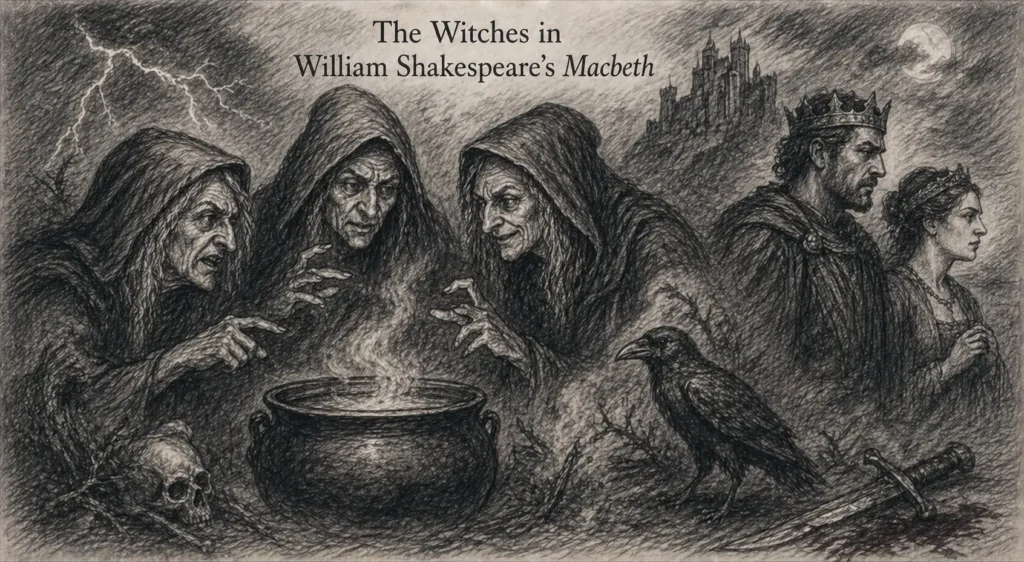
The Witches in William Shakespeare’s Macbeth
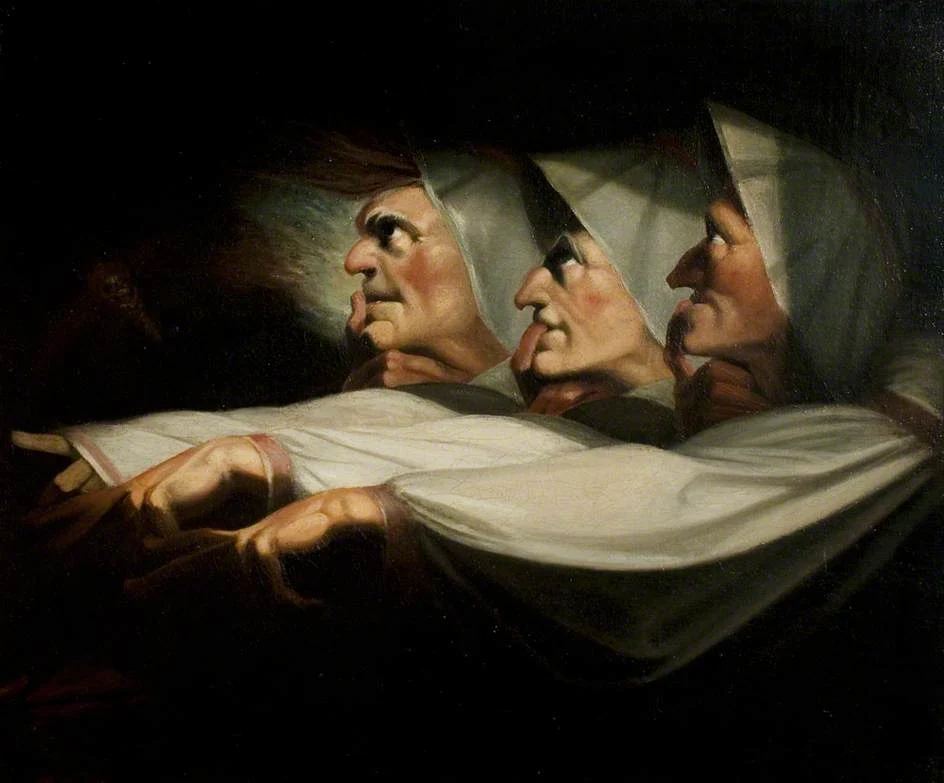
Image taken from Wikipedia
INTRODUCTION:
Macbeth is ‘The Bards’ most well-loved tragedy. Shakespeare wrote Macbeth in 1606 in Scotland amidst the darkest period of witch hunting in early modern Europe which spanned a period from 1450 to 1750. A witch was defined as someone who had allegedly gained magical powers by obeying Satan, this definition of witchcraft spread through churches in Western Europe starting at the end of the 15th century. It gained attraction after the Pope gave permission to conduct enquiries in search of witches in 1485.
INCEPTION OF THE WITCH-HUNT
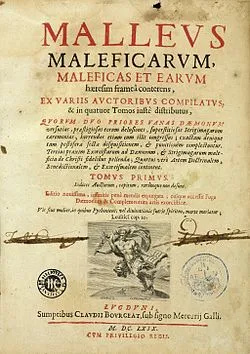
Image taken from Wikipedia
There came a book called Malleus Maleficarum also known as The Witches Hammer by Heinrich Kramer in 1487. Kramer was a demonic monk whose book became amazingly popular for over a century it was the second bestselling book after TheBible; the book argues that Satan due to the fact that Apocalypse is coming has,
“Caused a certain unusual heretical perversity to grow up in the land of the Lord — a Heresy, I say, of Sorceresses, since it is to be designated by the particular sex over which he (Satan) is known to have power.” (Mackay, 69)
The book goes on to describe in details of the many evils of these mostly female practitioners of witchcraft and advocate for an all-out war against them. Witches Hammer strongly argued that torture was an appropriate interrogation technique for potential witches. Amid all the religious, economic and social challenges of the century the hunt for witches accelerated and eventually became lethal.
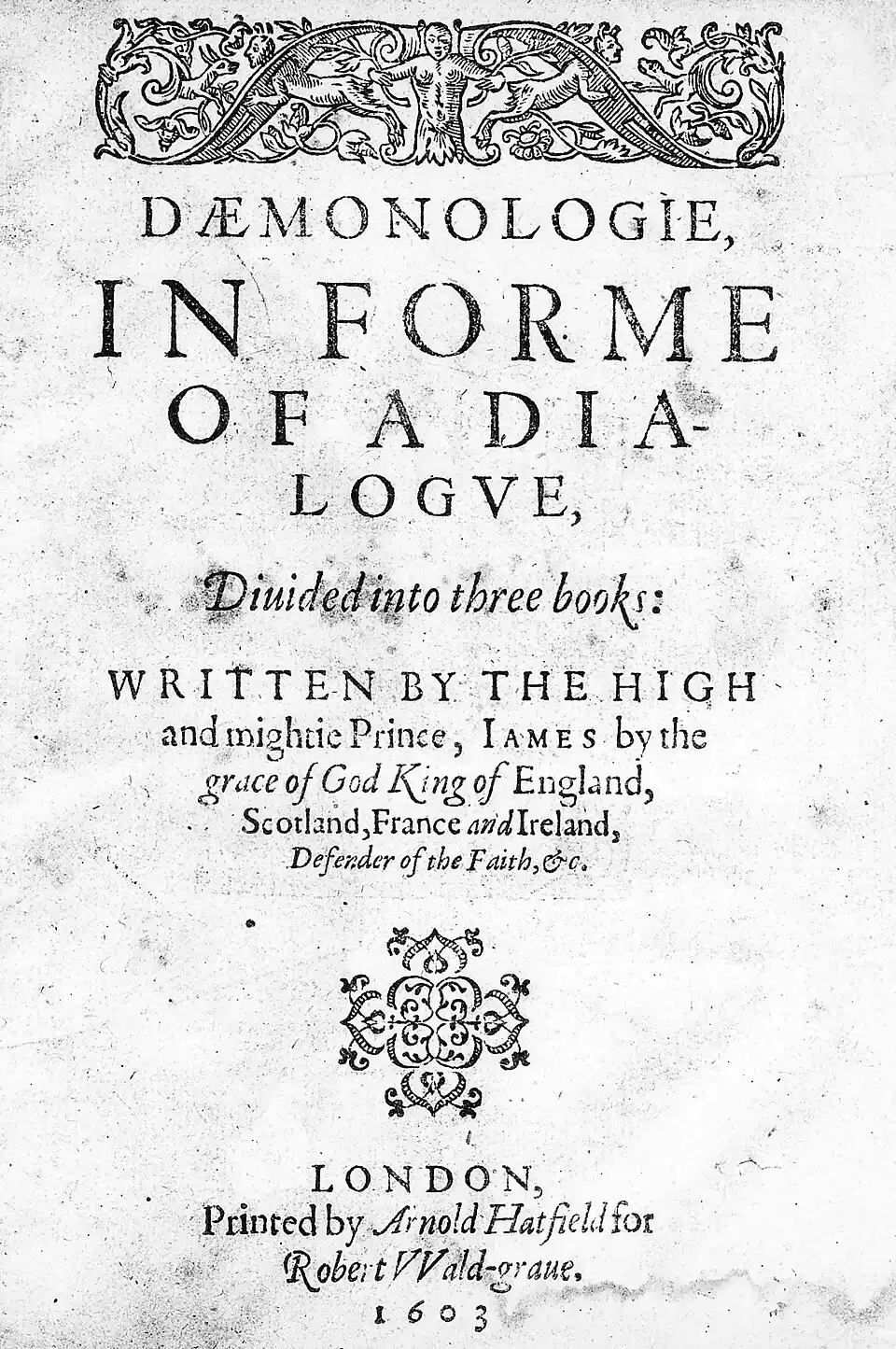
Image taken from Wikipedia
Puritans believed that the devil wreaked havoc in the world through human agents or witches, who blighted nature, conjured fiendish apparitions and tormented children. King James VI wrote a book called Daemonologie in 1597, which he starts by calling the witches as “detestable slaves of the Devil, the Witches or enchanters”.
He was deeply paranoid about the threat posed by a coven of witches, who he believed had tried to kill him by drowning him while he was at sea. King James ascended throne in 1603, just a year before the arresting panel for witch trials was formed. King James had a reputation as an avid witch-hunter and he participated personally in many trials. Finally the King James Bible was published 1611 which laid out in stark words:
“Thou shall not suffer a witch to live…” (Exodus 22:18)
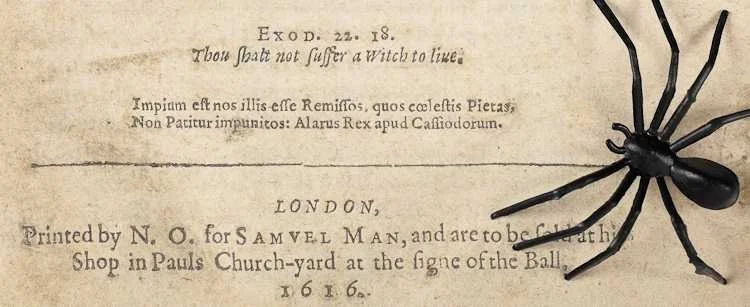
Image taken from Shakespeare Birthplace Trust website website
“In Daemonologie, King James uses dramatic form to admonish his readers about the dangers of necromancy, a dissertation that precedes Shakespeare’s Macbeth and clearly articulates religious reasons for presenting witches.”(Steelman,142) Thus, the idea to bring in the themes of witchcraft in Macbeth, was not only a way to capture the interest of the audience but also of the King.
WHICH is a WITCH:
Historians point to the concentrated focus on the women during the witch trials and conclude that the accused were the most vulnerable and often the most disrespected in the society. Others point out that women were the main victims because religious scriptures referred to the female body as the most impure and most vulnerable to evil.
The accused were mostly pregnant, single women, or lying in nurses, or the ones long absent from churches. Widows with no male heirs and ones who owned vast lands were easy to blame. Non-Christians and outcasts who lived on the edges of the society, who were poor, old and unprotected were easy to blame. Strong willed, wealthy or self-sustained women who knew their way in the society were targeted often.
WITCH TRIALS:
The suspect was stripped off clothing and she was shaved off bodily hair so that the torturer could minutely examine the body for all the diabolic signs that had come down from the devil as the witch’s mark as mentioned in various manuals and books of Daemonologie (Warts, moles skin tags, hardened nipples or sagging breasts, any bodily deformation was seen as important evidence of one being a witch).
Water was considered pure and was used as common means to determine witches, the accused would be tied and thrown in water, if she sank then it meant that the water had ‘accepted’ her, which meant she was pure; if she floated then the water had ‘rejected’ her and she was evil. Most accused ended up drowning by this trial method. The victims would then be tortured and they would make false confessions which led to execution.
This picture of widespread torture and execution speaks of how profoundly afraid people were of the Devil and his influence in those days. Many died of torture and in imprisonment in Europe, where historians believe tens of thousands of women were executed for witchcraft in the 16th and 17th centuries.
Shakespeare’s WITCHES:
Shakespeare never actually used the word ‘witch’, in Macbeth, instead he used the term ‘wyrd’ or ‘The Weird Sisters’ (‘wyrd’ is an Old English word, which means ‘fate’ or ‘destiny’). The first folio edition (1623) of Macbeth never shows a mention of the word ‘witch’ instead ‘weyward’.
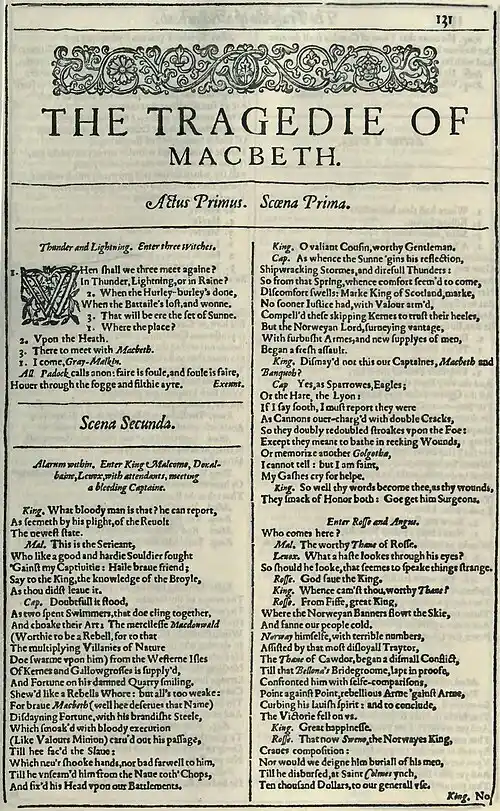
Image taken from Wikipedia
He wrote Macbeth at a time when interest in witchcraft bordered on hysteria and witch hunt was on its peak. Hence, a play which opens with supernatural or the witches would have been a huge draw for the audience during the Jacobean Era.
Shakespeare paints his witches as were the common believes of the society, including the physical appearance of a witch. The ‘witch’s marks’, a mark supposed to have been put on the women’s body by the devil, is reflected in Banquo’s description of the witches in Act 1 Scene 3, depicting them as stereotypical hags, ‘withered’ and ‘wild’, unearthly beings “that look not like th’ inhabitants o’ th’ Earth”(42) with ‘skinny lips’ and ‘choppy fingers’ and beards.
Also according to the contemporary beliefs, animals were supposed to be the witch’s demon advisors or their assistants in their diabolic plans, which accounts for Shakespeare’s witch’s ‘familiars’ mentioned in Act 1 Scene 1 as ‘Graymalkin’ the cat and ‘Paddock’ the toad.
He uses literary devices to set the witches apart from other characters. While the nobles speak in iambic pentameter; the form used by the witches is trochaic tetrameter.
“Fair is foul, and foul is fair”(1.1.12)
Use of such literary device heightens the sense of other-worldliness and makes them stand out from the rest of the characters, emphasizing their wickedness. We also notice that the witch’s dialogues are full of numbers, specially the number three. There are three witches, and they meet three times, and they talk about three a lot, or thrice, and they repeat things three times!
“Thrice to thine and thrice to mine And thrice again, to make up nine.” (1.3.36-37)
Shakespeare uses the repetition and the audiences’ association of three with power and magic, to his advantage. Many of their lines are in rhyming couplets. The image of otherworldly threatening figures chanting in unison created a stocking unsettling atmosphere like the very famous lines of the song of the witches:
“Double, double toil and trouble; Fire burn, and cauldron bubble.”(4.1.10-11)
Shakespeare’s plays use a variety of forms of the natural world throughout, such as the sea, air and wind, Earth and wildlife, thunder and lightning. Witches in Macbeth are shown to have the power of controlling weather but what remains as a very debatable question is ‘how much power do these witches possess?’. This happened to be the topic of a 2010 Oxford University lecture debate where Dr. Emma Smith points out that throughout Act 1 Scene 1 the witches seem to know what is happening and what would follow. For Smith, the Bards use of dramatic irony is a key in suggesting that the witches are not as powerful as they first appear to be.
In Act 1 Scene 3, the witches announce Macbeth as the ‘Thane of Cawdor’, later when the same was informed to him as a truth, it appears to him that the witches made it happen, but to us, the audience, it was clearly a result of a rational political reason.
So, are the witches puppeteers of Macbeth’s ambition or just prophesiers? Smith argues that the witches “interpose in a chain of human actions rather than… direct actions themselves”. Shakespeare answered the very question by calling them the ‘Weird Sisters’. As if to assist us in drawing the conclusion, in Act 1 Scene 3 the witches discuss the limitation of their powers. We see that the witches have the power to control the wind and use it to disrupt the sailor’s journey; however they do not have the power to take his life.
“Though his bark cannot be lost, Yet it shall be tempest-tossed.”(1.3.25-26)
Kramer writes that “witches were among many other things practicing cannibalism and causing male impotence” reflecting the first witch’s line
“I’ll drain him dry as hay”(1.3.19)
This phenomenon is famously called ‘mischief following anger’. Act 3 Scene 5, is believed by many scholars as not written by the original writer, instead by the actors to either give themselves more lines or to excite the audience. Hecate, a character which had not been introduced previously, is announced as
“the mistress of your(witches) charms”(3.5.6)
This scene questions the powers of the witches as they are reprimanded by their superior. Finally Act4 Scene1, portrays the witches’ power of deception. As Hecate, says,
“And you all know, security is mortals’ chiefest enemy”(32-33)
The witches present the three apparitions to Macbeth to deceive him into a false sense of security, depicting the witches’ nature of speaking in riddles and half-truths. The witches are always seen in threes and never alone. “The idea of the sabbat was at its peak just after Macbeth was written, so it was probably something his audience may have heard about” (Sharpe,164). The witches not only represent the dark powers they have and their ability to influence men’s decisions but most importantly they are an outward representation of Macbeth’s inner evils.
Lady Macbeth, Shakespeare’s 4th WITCH:
Shakespeare portrayed witches as strong willed and domineering women, and these are some traits that Lady Macbeth seems to have in common with them.
“Look like th’ innocent flower, But be the serpent under’t”(1.6.76-77)
Numerous debates arise regarding whether the writer presents Lady Macbeth as the fourth witch. For the 17th century audience, Lady Macbeth could have been the image of the fourth witch, with scenes depicting Lady Macbeth summoning evil spirits to unsex her, after which emerges a ruthless unladylike character desperate enough for power to be willing to assist Macbeth in King Duncan’s murder.
The irony is Shakespeare presents Lady Macbeth as a clear picture of women’s power of influence and female dominance in a society where there was none and the tragedy is that the contemporary society would not have tolerated, had Lady Macbeth met a better end. To us the 21st century audience Lady Macbeth is a powerful and ambitious woman, who suffered a climax she did not deserve.
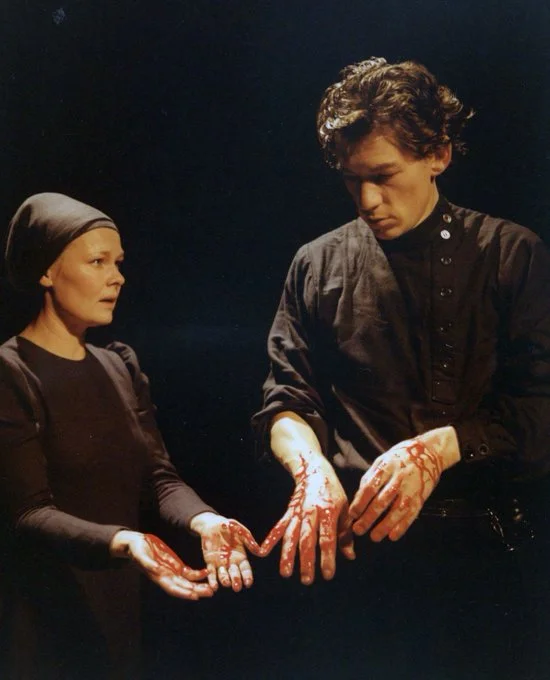
and lan McKellen as Macbeth (1979), Macbeth drama adaptation)
Image taken from BBC
“Her pain is absolutely paramount. And I think that is what she dies of – she has nothing left. There’s nothing left for her to live for and that’s the tragedy of it.” said Judi Dench on playing Lady Macbeth.
Lady Macbeth suffered a fate worse than any other character, drifted apart from the husband she loved, tortured by the visions, driven into delirium due to all the guilt and remorse, and finally left alone only to die off screen. She says,
“Hell is murky”(5.1.38)
implying that she already knew the darkness intimately. Indeed Lady Macbeth was one of the most tragic heroines of the Bard.
Genius of Shakespeare:
The ideas about witchcraft changed quite rapidly in England, the first play of Macbeth was enacted in 1606, writing in 1745 about the play, Samuel Johnson said that “In order to make a true estimate of the abilities and merit of a writer, it is always necessary to examine the genius of his age, and opinions of his contemporaries. A poet who should now make the whole action of his tragedy depend upon enchantment, and produce the chief events by the assistance of the supernatural agents, would be censured as transgressing the bounds of probability, he would be banished from the theatre to the nursery, and condemned to write fairy tales instead of tragedies.”
From the late 17th century through the mid-18th century, with the rise of a stronger Central Government with legal norms, witch hunting slowly declined until it disappeared. The 1735 Act reduced the penalty for practicing witchcraft from death to one year in prison, this law change reflected a shift from actual believe in witchcraft to punishing those who made a pretense of having special powers. Both the onset and demise of this evil chapter in history came gradually out of seemingly ordinary circumstances. So, is the genius of Shakespeare, he taps in contemporary obsessions and ideas to make his work relevant to his audience.
IN A NUTSHELL
Shakespeare mentions witchcraft in not only Macbeth but many other of his work including Henry VI, The Tempest, Richard III, The Comedy of Errors and The Merry Wives of Windsor. He was very skeptical about witchcraft and his casual mentions of these supernatural beings in his works prove it. Shakespeare’s witches act as a blueprint for many other modern witch characters. Many modern versions of these witches which we see today in the art field like Ursula, Bonnie Bennett, Hermione Granger, and The Scarlet Witch are the total contrasting image of Shakespearean witches in appearance and intentions, but their ambitious, strong-willed, powerful and dominant nature still remains the same.
Macbeth not only acts as a 17th century social document, depicting the horrors of the witch-hunt era, but also acts a forerunner for many other fantasy fictions to follow.
Stay tuned for next episodes as we decode further Literature tales and stories.
Meanwhile you can read the episode two on “Folly in William Shakespeare’s Twelfth Night“
WORKS CITED:
- Johnson, Samuel. “Observations on the Tragedy of Macbeth”. Miscellaneous Observations on the Tragedy of Macbeth. 1745. (Web)
- Mackay, Christopher S. The Hammer of Witches: A Complete Translation of the Malleus Maleficarum. 2009. (Web)
- Shakespeare, William. The Tragedy of Macbeth. Edited by Barbara A. Mowat and Paul Werstine, Folger Shakespeare Library. (Web) [All the textual quotations have been taken from here.]
- Shakespeare, William. Macbeth. Edited by Sandra Clark and Pamela Mason, The Arden Shakespeare, Bloomsbury. 2015. (Print)
- Sharpe, James. “In Search of the English Sabbat: Popular Conceptions of Witches’ Meetings in Early Modern England”. Journal of Early Modern Studies.Vol.2, 2013. (Web)
- Steelman, Sheridan Lynn. 16th Century Shakespeare and 21st Century Students. Western Michigan University. 2017. (Web)
PODCASTS CITED:
- Dench, Judi. On Playing Lady Macbeth. Bbc. 24 march. 2016.
- Smith, Emma. Who or What makes happen the things that happen in Macbeth. University of Oxford. 02 November. 2010.
Pingback: Shakespeare Simplified & Storified, Episode 2