


Introduction
As tears form the basis of tragedy; laughter, contentment and happiness form the basis of comedy. Why do people laugh? Do they laugh only when they are happy? It is surely true that in congenial company people do laugh because they are happy in that company. Boisterous laughter like in Comedy of Manners is a very common thing among young people for which older people do not generally find any cause.
Horace Walpole very epigrammatically said once that this world is a comedy to those that ‘think’ and tragedy to those that ‘feel’. Younger they are, more ready they are to enjoy life, perhaps because they do not ‘think’. Thoughtless laughter is not uncommon among even older men as is very evident from the pleasure that most cheap comic scenes on the stage or screen, which are merely ‘crazy’, give them, even when improbable. The explanation given by thoughtful men is that men laugh in such cases because of “superiority complex”, because unsympathetic observers feel that they themselves would not have been in that position.
There is truth in the observation of a critic that if a comic stage waiter slips on the stage and breaks the plates and glasses on his tray it is likely to raise ripples of laughter, and anybody disapproving that laughter will be regarded as a kill-joy. It is on such unsympathetic attitude of this people in general that originally comedies depended for success.
THE GENRE OF COMEDY
“Nothing in nature is categorically comic –whether it is or not depends on what you make of it”. (Potts) It is often incongruity which makes us laugh. A child wearing a false moustache and imitating the behaviour of old men would make people laugh. Old Gobbo with impaired eyesight in The Merchant of Venice becomes an object of laughter when he touches the hair of his kneeling young son’s head and mistakes it for his bearded cheek.
The comedy on the stage at one time “was a safety valve on outlet for disorderly passions including erotic passions; and by treating them in an unserious spirit it rendered that less dangerous socially.” : (L.J.Potts; Comedy) The modern concept of comedy : “A light and amusing stage play with a happy conclusion to its plot” This idea is very different from the classical original conception that is a drama meant for correction of faults of individuals or the society through laughter. The purpose being what it was, that is correction, the laughter was imagined.
George Meredith in his Essay on Comedy observes that men are attracted by the honesty and shapeliness in the present and not an imagined future world. The comic spirit casts a malign and oblique light on men when they “wax out of proportion, overblown, affected, pretentious, bombastical, hypocritical or drift into vanities and violate one another.” Portrayal of such human beings is, in Aristotle’s version, “an imitation of men lower than average”.
Aristophanes (444-380 B.C.) in his comedies attacked individuals like Cleon as well as war and other unwanted things. Menander (340-292 B.C.) created a type of comedy called New Comedy which may be called the Comedy of Manners, Contemporary Figures, “ the fathers and sons of Hellenistic society, the slaves and the cooks and musicians, the old gossips and the parasites, the young wives and, above all the courtesans. “
Though only one of his comedies in complete form (The Grouch) is extant we come to have an idea of them from two Latin comedy writers, Plautus (254-184 B.C.) and Terence (193-159) who took as a model the New Comedy of ancient Greece. The laughter which rings through their plays at some characters like mothers-in-law and senile husbands is unsympathetic and often very cruel. The Athenians; after losing at their own pretensions and shortcomings.
Comedy has assumed different shapes while passing through centuries. In some modern comedies exposure of defects is done through cruel unsympathetic laughter. Ben Jonson in England and Moliere in France, have done it. But such plays do not please as much as those comedies which evoke sympathetic laughter and pleasure which is anything but malicious. Shakespeare created heroines like Beatrice, Portia, Rosalind and Celia in his comedies, and characters like Launcelot Gobbo, Falstaff, Sir Toby Belch etc. for evoking such sympathetic laughter.
As a form of art it started “for life’s sake”. Writers of comedy pursued a purpose, the purpose of exposing and correcting follies. Naturally basic realism had to be there. Without portrayal of reality that purpose could not be served, though in ancient drama often a veil of unreality was introduced. Varied types of comedy gradually evolved to give pleasure to the spectators and often the element of instruction has disappeared.
COMEDY vs COMEDY OF MANNERS
Realistic portrayals of different sections of a society in such a way as to make spectators laugh at the follies of the men portrayed make comedies but all comedies do not necessarily fall under the class called “the comedy of manners”. This is a distinct genre in which emotion, which for generations has made plays like The Merchant of Venice, As You Like It and Twelfth Night touch the heart of spectators plays little part.
The aristocratic society of King Charles II’s days, careless and interested in amorous intrigues was mirrored in such comedies written by George Etherage, William Wycherley, William Congreve, George Farquahar, Sir John Vanbrugh and others which are specifically referred to as “comedy of manners”. These are mainly intellectual, mirroring the affectation and the then culture of the “fine society”. Ben Jonson’s plays: Alchemist, Volpone, Every Man in his Humour etc. in which common men and women were portrayed, do not come under the category from that point of view, though the comedy of manners from another point of view has certain characteristics of the Comedy of Humour to which Ben Jonson’s comedies belong.
Even G. B. Shaw’s In Good King Charles’ Golden Days, in which the king, his brother Duke of York the king’s mistresses play their roles along with the mathematician Newton and his domineering house-keeper cannot be called a “comedy of manners”. It has wit, humorous situations but lacks the mark of sophistication of the Restoration society and the comedies of that period mirroring the amorous intrigues which was fashionable in that age.
COMEDY OF MANNERS
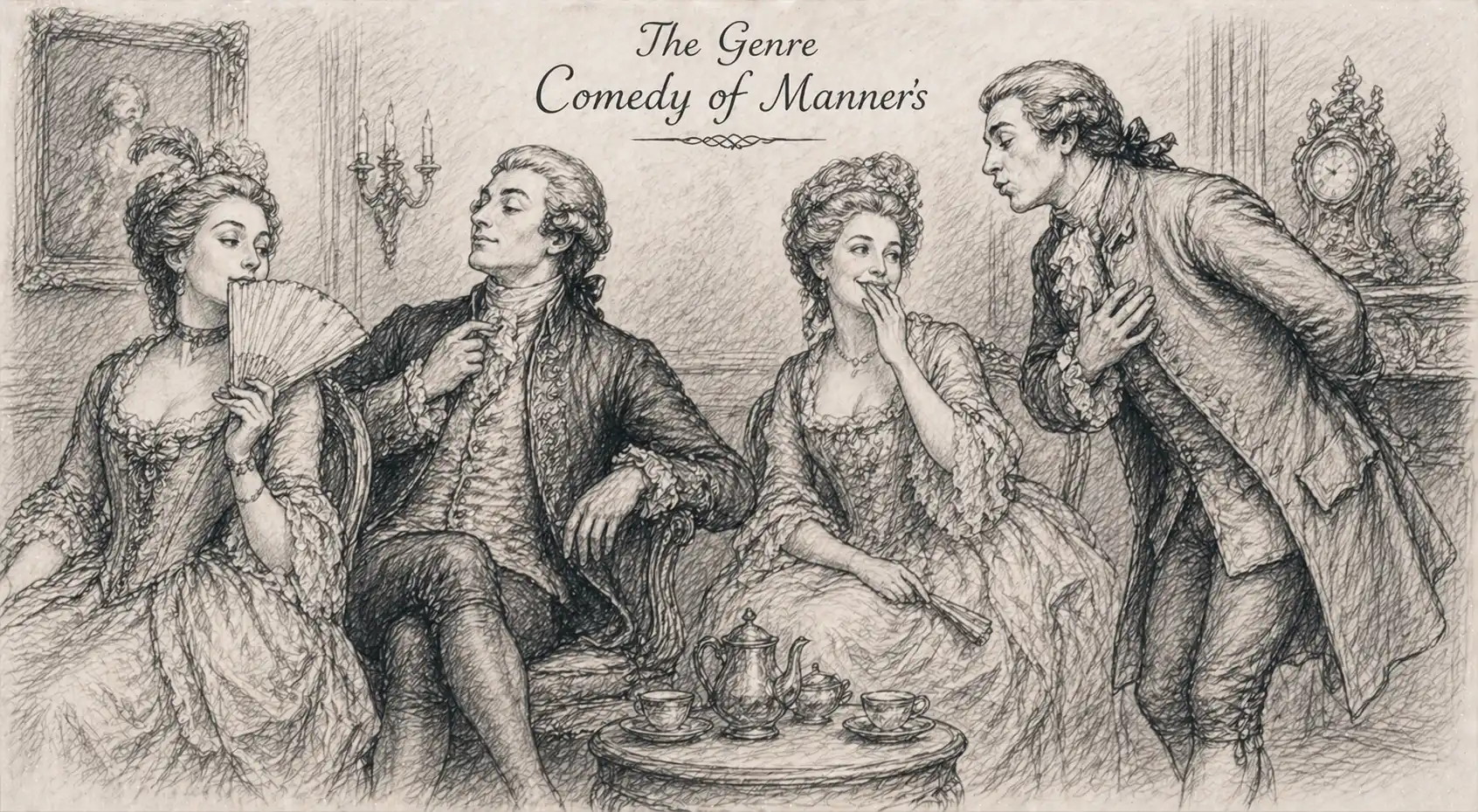
In a broad sense, Comedy of Manners mirroring the contemporary society (excluding the poorer section) may be found in every age and every country. According to a modern definition “this genre has for its main subject and themes the behaviour and deportment of men and women living under specific social codes. It tends to be preoccupied with the codes of the middle and upper classes and is often marked by elegance, wit and sophistication”.
“Their object”, according to Allardyce Nicoll, “was to display the fashionable life of their time, not to indicate the superior mental and moral qualities of a past age or to prophesy concerning the improvements of the future.” “The fine society” was dilettante, careless, intent only on pleasure and amorous intrigue, so that the comedy which depicted it has an air of abandon and of immorality which is markedly different from the manlier temper of the Elizabethan stage.” From such a broad point of view even some Greek comedies of Aristophanes and Latin comedies of Plautus and Terence fall under this category.
Shakespearean comediesLove’s Labour’s Lost (1595) and Much Ado About Nothing (1598-9) have some characteristics of some plays of Moliere, and are distinctly comedies of manners. In Sheridan’s School for Scandal (1777) Sheridan has depicted the scandal-mongering nature of the upper class men and women with an abundance of wit and absence of sympathy, which brings it within this class. Oscar Wilde in the last decade of the nineteenth century depicted the society men and women inThe Importance of Being Earnest, Lady Windermere’s Fan and other plays.
Somerset Maugham and J.B. Priestley have also produced several comedies of manners. Priestley’s When We Are Married is a sly sketch of provincial manners and attitude dealing with Yorkshire men and women whom the writer knew as a boy. If we take a broadcasting station as a part of the society, his Good Night Children is a comedy of manners based on the problem in a broadcasting station. Gambling in the share market is no doubt a part of the activities of men and women.
Golden Fleece depicts the sudden advent of a big gambler and its effect not only on the financial world but also on the people connected with it. As a night porter in the hotel ‘Golden Fleece’; William Lotless is humorous, lovable and quite contented. But success, in playing in the sharemarket with millions makes him arrogant and dyspeptic and lose his natural charm of manner. Only when after another turn of the wheel he has to stop his operations and lose his great power (the power which corrupts) he will be really happy.
“He will be in sole charge of this hotel which he can run on new lines, using some of his own ideas. One of his dreams will come true. It will no longer be a hotel for fat, rich and disgusting people. It will be a heaven for ‘people’ who have been working too hard and not eating too much, for men who are of some use in the world, for women who deserve to be waited on for a change – for real people.” Unlike the comedy of manners of the seventeenth century England, Priestley’s plays have generally some wisdom to impart.
Some dramatic critics however are in favour of attaching narrower sense to the term “comedy of Manners”. They use the term to indicate the comedies written by only a few dramatists writing mainly during forty years, between 1660 and 1700, Sir George Etherege (1635-91), William Wycherley (1640-1716), William Congreve (1670-1729), George Farquhar (1678-1707), Sir John Vanbrugh (1664-1726) and a few others.
Some of the famous Restoration comedies are Congreve’s The Way of the World; Shadwell’s Sullen Lovers and The Humorists. Sir George Etherege wrote The Man of Mode (1676). William Wycherley wrote The Country Wife (1675) and The Plain Dealer (1676). William Congreve’s plays The Double Dealer (1693), Love for Love (1695) and The Way of the World (1700) are based on amours as all Restoration comedies are, but there is little passion in them.
We find in them condemnation of deviation from wit and good manners. In The Old Bachelor, for example, there are two groups of characters, ‘the wits’ and ‘the gulls’. The former claims the sympathy of the audience for providing grace and style and the latter are condemned. Farquhar’s claim for distinction depends on two interesting comedies, The Recruiting Officer (1706) and The Beaux Strategm (1707). In the former we are reminded of Falstaff as a recruiting officer.
Farquhar seems to have been satirising the way soldiers were recruited in his own time. A scene before the justices is full of realistic details. An immoral tone pervades all through. Even the heroine, Sylvia is planning to marry Captain Plume against the wishes of her father, dressing herself as a soldier, impertinently uses the indecent language of the soldiers of those days.
The main plot in Beaux Strategm is full of varied adventures. In it is portrayed the hard life of a woman with a brutal husband. The beaux, Aimwell and Archer, in their search for rich wives succeed in the adventures at Lichfield. In Sir John Vanbrugh’s The Provoked Wife (1697), too, we have a striking portrait of the matrimonial cruelty of Sir John Brute and the natural reactions of his wife expressed in the cynical attitude to virtue and fidelity. But in the very first scene, in her soliloquy her future course of action is drawn.
“I think I have a right to alarm this surly brute of mine; but if I know my heart, it will never let me go so far as to injure him.” There is mild flirtation but in the end she does not ‘injure’ him. The shock treatment makes him seek her forgiveness. The typical immoral woman is portrayed in Lady Fanciful and in Sir John Brute’s description of the daily life of a woman of quality (IV.iii). Among his comedies this is “probably the soundest and The Confederacy (1705) the “most immoral”.
Conclusion
All these dramatists concerned themselves with the outward behaviour of the characters, their norm was the conventions and standard of a group of people of that period. They were not concerned with the psychology of the character or permanent and universal principles. The significance of such comedy of manners is naturally narrow and their occasional revival is for the brilliance of dialogue in some of them.
Stay tuned for next episodes as we decode further Literature tales and stories.
Meanwhile you can read the first episode of Shakespeare Simplified & Storified on ‘The Witches in William Shakespeare’s Macbeth‘.
BOOKS CITED:
- J.A. Cuddon, The Penguin Dictionary of Literary Terms and Literary Theory
- L.J. Potts, Comedy
- W.R. Goodman, Quintessence of Literary Essays, New Delhi, 2008.