

T. S. Eliot in The Sacred Wood “Tradition and the Individual Talent” (1920): “Poetry is not a turning loose of emotion, but an escape from emotion; it is not the expression of personality, but an escape from personality. But, of course, only those who have personality and emotions know what it means to want to escape from these things.”
Concept of Modernism:
Modernism was viewed as “a rejection of traditional 19th-century norms, whereby artists, architects, poets, and thinkers either altered or abandoned earlier conventions in an attempt to re-envision a society in flux.” Modernism was also mainly represented by orientation towards fragmentation, free verse, contradictory allusions, and multiple points of view different from Victorian and Romantic writing.
Modernism in literature consciously tries to adopt a position that is anti-Romantic and Victorian. It tries to present experience in terms of an uncertain, lonely, and confused perspective. The voice of the modern poet is thus tentative and not assertive. Modern Poetry is a poetry of crisis of choice and identity. All the enduring certainties of Enlightenment thinking, and the heretofore unquestioned existence of an all-seeing, all-powerful ‘Creator’ figure, were high on the modernists’ list of dogmas that were now to be challenged, or subverted, perhaps rejected altogether, or, at the very least, reflected upon from a fresh new ‘modernist’ perspective.
Eliot as a Modernist:
“The doctrine of ‘art for art’s sake, a mistaken one, and more advertised than practiced, contained this true impulse behind it, that it is a recognition of the error of the poet’s trying to do people’s work.” – T.S. Eliot in The Use of Poetry and the Use of Criticism.
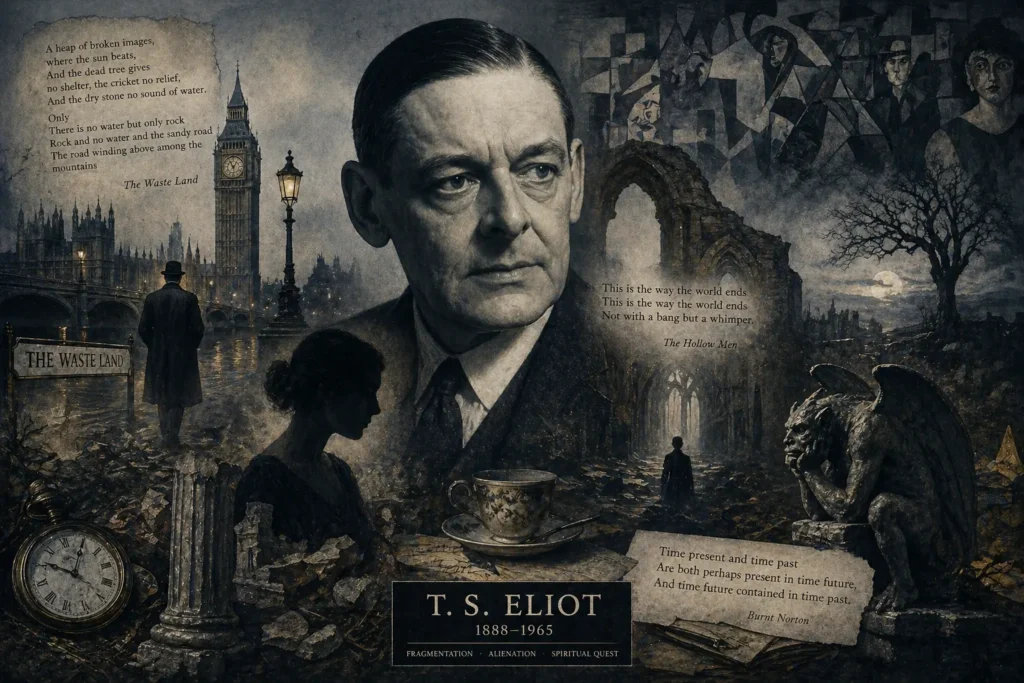
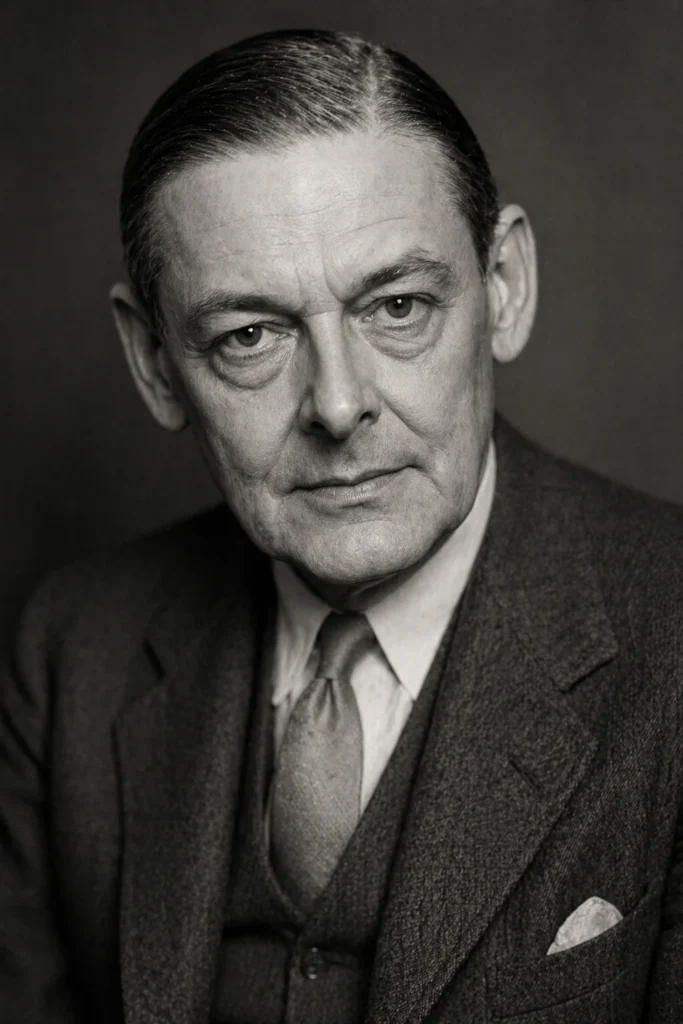
T.S. Eliot, considered the father of Modern Poetry, a significant literary figure in the twentieth century, was one of the founding members of the modernist movement in poetry. He initiated a new stream of poetry, that was cerebral, impersonal, imagistic, urbane, ironic and observational. His works highlighted the modern society and its dilemmas; and beautifully evokes the fragmented human experience vainly striving for meaning in life. He represents “the quintessence of an age riding on the waves of new-fangled ethos”.
In his poetry, Eliot combines both, concern with religious issues (medieval theme) and a trend towards contemporary issues (modern theme). So as critics observed, Eliot seeks some sort of “integration” between the two aspects[1]. One of the fundamental characteristics of modernism is the production of meaning from fragmentation. The frequent images of falling and decay are representative of modern life. Life is represented as trivial, suffering from the problems of war. This all happens on both the real physical level and the inner psychological level of the modern man.
The poem’s broken imagery, stream-of-consciousness style, and other peculiar stylistic elements are employed to help the poet convey his message. For Eliot, modern life is fragmented and illogical; thus he conveys through his style[2]. He uses stream-of-consciousness to illustrate the chaos in of the modern man’s thinking. He also employs a variety of modernist methods, including fragmentation, repetition, and imagism. All these techniques help depict the modern life for the reader and reflect its status in real manner.
Eliot believes that poets should look for ways to express their emotions implicitly and he sees “objective correlative” as a solution. He states: “The only way of expressing emotion in the form of art is by finding objective correlative; in other words, a set of objects, a situation, a chain of events which shall be the formula of that particular emotion; such that when the external facts, which must terminate in sensory experience, are given, the emotion is immediately evoked” (qtd. in Thorne 282)[3].
Critic Sara Thorne states that “unlike the Romantic poets, Eliot attempts to convey the essence of life; and the content represents actual contemporary life rather than an escape from the grinding nature of reality.” (281).
Separation of art from the artist:
“The more perfect the artist, the more completely separate in him will be the man who suffers and the mind who creates”. – T. Eliot in “Tradition and the Individual Talent” (1920)
Elliot, proclaims of the absolute difference “between art and the event” and this is seen in Eliot’s criticism as it can be seen working in his poetry. Eliot disapproved of personalization of poems. “The poet has, not a ‘personality’ to express, but a particular medium, which is only a medium and not a personality, in which impressions and experiences combine in peculiar and unexpected ways… Poetry is not a turning loose of emotion, but an escape from emotion; it is not the expression of personality, but an escape from personality” wrote Eliot in his essay named ‘Tradition and the Individual Talent’ in 1917, to back up his argument.
In his book titled ‘The use of poetry and the use of Criticism’, Eliot disagreeing Sidney’s approach in ‘An Apology for Poetry’ writes that “Sidney’s assumption is that poetry gives at once delight and instruction, and is and an adornment of social life and an honour to the nation. I am very far from dissenting from these assumptions…”
Eliot writes that, “If poetry is a form of ‘communication’, yet that which is to be communicated is the poem itself, and only incidentally experience and the thought which has gone into it. The poem’s existence is somewhere between the writer and the reader; it has a reality which is not simply the reality of what the writer is trying to ‘express’, or of his experience of writing it, or of the experience of the reader or of the writer as a reader.” According to Eliot the writer works only as a catalyst of emotions, and thus the pot and the poem are two separate entities,
Eliot’s modernism vs faith:
“We know too much, and are convinced of too little. Our literature is a substitute for religion, and so is our religion.” -T. S. Eliot in “A Dialogue on Dramatic Poetry” (1928)
The guarded nature of modern poetics is an acknowledgement that the perceiving self does not naturally draw upon divine knowledge and is not an alien to matter. It is a lonely self trying to understand the act of living as evident in terms of its experiences, seeking an intersection between immeasurable and measurable realities. Eliot believed that a universal religion would be the religion that would unify morals everywhere.
Manju Jain notes, that Eliot acknowledged that his poetry showed the influence of Indian thought and sensibility. He employs literary and cultural allusions from the western canon, Buddhism and the Hindu Upanishads. He was intrigued by several religions but at the age of 39 and a well-established literary figure, he was baptized into the Church of England. The reaction of some of Eliot’s British contemporaries to his conversion ranged from mild disbelief to full-throated contempt[4].
Eliot encapsulated his views as “classicist in literature, royalist in politics, and Anglo-Catholic in religion.” Cleo McNelly Kearns in her essay ‘Religion, literature, and society in the work of T.S.Eliot’ notes that, “Eliot felt keenly the value of the rare moments of ‘easy and natural’ association between literature, religion and society (though he noted that “many of the most remarkable achievements of culture” had been made “in conditions of disunity”) and he spoke with eloquence of their combination of underlying order and deliberate if controlled cultivation of differences in point of view.”
Kearns also comments that, “In general, he(Eliot) insisted that all writers must recognize something outside themselves to which they owed ‘allegiance’ and ‘devotion’, something in the light of which sacrifices of idiosyncrasy, personality, and ideology might with justification be made.”
Modernism in Eliot’s poems:
“To do the useful thing, to say the courageous thing, to contemplate the beautiful thing: that is enough for one man’s life.” ― T.S. Eliot, The Use of Poetry and the Use of Criticism
Modernist literature can be viewed largely in terms of its formal, stylistic and semantic movement away from Romanticism, examining subject matter that is traditionally mundane, a prime example being Eliot’s ‘The Love Song of J. Alfred Prufrock’. Edward Albert commenting about Eliot’s ‘Prufrock’ says, “The poet tries to plump the less savoury depths of contemporary life in a series of sordid episodes. The irregularities of rhyme scheme and line length in his verse form, the pressure of his condensed and often vividly contracted images, the skillful use of rhythmic variations, and the restrained power of his style distinguished Eliot as a gifted, original artist.”
The most important modernist technique in Eliot’s poem is the stream-of-consciousness technique. This technique reflects the fragmentary nature of the modern man’s mentality. It also a allows the reader to explore the inner self of the character. As seen in the poem, Prufrock’s thought shifts very often from trivial to significant issues and vice versa. This explains the idea of subjective time in modernism which is contradictory to historical time of past, present and future.
As modernism stresses the ideas of pessimism and loneliness, the negative aspects of modern life are also stressed in the poem. Elisabeth Schneider clarifies that ‘The Love Song’ is more than a retreat from love, however; it is the portrait of a man in Hell, though until his truth is clearly realized, the hell appears to be merely the trivial one of the self-conscious individual in a sterile society (1104).
The poem ‘The Waste Land’ is often read as a representation of the disillusionment of the post-war generation. Dismissing this view, Eliot commented in 1931, “When I wrote a poem called ‘The Waste Land’, some of the more approving critics said that I had expressed ‘the disillusion of a generation’, which is nonsense. I may have expressed for them their own illusion of being disillusioned, but that did not form part of my intention.”
The poem is known for its obscure nature—its slippage between satire and prophecy; its abrupt changes of speaker, location, and time. This structural complexity is one of the reasons why the poem has become a touchstone of modern literature featuring a marked pessimism, a clear rejection of the optimism apparent in Victorian literature in favour of portraying alienated or dysfunctional individuals within a predominantly urban and fragmented society. Many Modernist works, like Eliot’s ‘The Waste Land’ are marked by the absence of any central, heroic figure at all, as narrative and narrator are collapsed into a collection of disjointed fragments and overlapping voices.
Sometimes referred to as Eliot’s “conversion poem”, ‘Ash Wednesday’ is richly but ambiguously allusive, and deals with the aspiration to move from spiritual barrenness to hope for human salvation. Eliot’s style of writing in “Ash-Wednesday” showed a marked shift from the poetry he had written prior to his 1927 conversion, and his post-conversion style continued in a similar vein. His style became less ironic, and the poems were no longer populated by multiple characters in dialogue.
Eliot’s subject matter also became more focused on his spiritual concerns and his Christian faith. Eliot himself regarded ‘Four Quartets’ as his masterpiece, and it is the work that most of all led him to being awarded the Nobel Prize in Literature. Although they resist easy characterisation, each poem includes meditations on the nature of time in some important respect—theological, historical, physical—and its relation to the human condition. Each poem is associated with one of the four classical elements, respectively: air, earth, water, and fire.
David Daiches says, “The repudiation of conventionally ‘poetic’ imagery, the organising of symbolic images, incidents, fragments of conversation or of memory without any explanatory links that would lower the pressure of meaning, the arresting of attention by imagistic shock or emotional anticlimax, the purging of self-pity by irony as well as the complete suppression of the poet’s own personality and his appearance only through the persona of his invented character – all this adds up to a new poetic style for English poetry. There are simpler poems in this collection, more imagist in technique; but in these monologues Eliot gave imagism a dialectic as well as symbolist dimension and a tone of intellectual irony.”
Conclusion:
Manju Jain notes that, “Whereas the early modernists had attacked tradition, championed the freedom of individual self-expression, and challenged the authority of rules and conventions. Eliot asserted the need for tradition, rejected the possibility of freedom in art, and denied the value of self-expression as the criterion for artistic achievement. He advocated classicism, impersonality, order and control, and a dialogue with the past-as opposed to romanticism, a rupture with the past, and unrestrained, anarchic individualism.”
In his writing one can enjoy the revival of the Metaphysical tradition of wit, allusion, conceit, colloquialism, ironic banter, etc. His poetics comprises a rare artistry which is hugely inspired by anthropology, psychology, occult and mysticism. Eliot was a sheer conjurer with words. He gave birth to unique prose and verse. His influence on modern poetic diction has been immense.
In his essay named ‘The Social critic and his discontents’ Peter Dale Scott writes that, “In Eliot, as in Yeats and Pound, we see the cultural alienation definitive of modernism, which drove all three poets to emigré obsession with the cultural defectiveness of their homelands.”
Stay tuned for next episodes as we decode further Literature tales and stories.
Meanwhile you can read the first episode of Shakespeare Simplified & Storified on ‘The Witches in William Shakespeare’s Macbeth‘.
[1] Critics argued that T. S. Eliot might be called a medieval modernist because of his “admiration for the organic and spiritual community of the Middle Ages together with his ‘impersonal’ conception of art, his elitist and formalist views isolate him from several of the central terms of the tradition”. In other words, some characteristics of Eliot’s work exhibit medieval themes and style; at the same time, these works are also rooted in the modern orientation of literature.
[2] Eliot poetry is also influenced by Albert Einstein’s Theory of Relativity. It believed in the flow of motion perceived differently in different positions. In art, it is translated into variety of the flow of perceptions. It gave a unique style of multiple voices in the poem where different opinions flow in the poem echoing the different experiences of the same experience. Eliot developed the concept of self. He was influenced by Sigmund Freud’s Psychonanalysis and depicts the human self.
[3] It must also be acknowledged, as Chinmoy Guha showed in his book Where the Dreams Cross: T S Eliot and French Poetry (Macmillan, 2011) that he was deeply influenced by French poets from Baudelaire to Paul Valéry. He himself wrote in his 1940 essay on W.B. Yeats,”The kind of poetry that I needed to teach me the use of my own voice did not exist in English at all; it was only to be found in French.” T.S Eliot was highly influenced by the French Symbolists who thought that “it was impossible to use conventional language to convey sensations as we actually experience them” (Thorne 279).
[4] For example, the novelist Virginia Woolf, an atheist wrote, “I have had a most shameful and distressing interview with poor dear Tom Eliot, who may be called dead to us all from this day forward. He has become an Anglo-Catholic, believes in God and immortality, and goes to church. I was really shocked. A corpse would seem to me more credible than he is. I mean, there’s something obscene in a living person sitting by the fire and believing in God.”in a letter to her sister Vanessa in 1928, as reported in the LRB by Colm Tóibín on 23 October 2014.
Works Cited:
- Albert, Edward. History of English Literature. India: Oxford UP, 1979. Print.
- Daiches, David. A Critical History of English Literature (Volume 2). India: Supernova Publishers, 2010. Print.
- Eliot, T. S. The Use of Poetry and the Use of Critism. London: Faber and Faber Limited, 1933 .Print.
- Jain, Manju. A Critical Reading of the Selected Poems of T.S.Eliot. Oxford University Press, 1991. Print.
- Moody, A. D. (Ed.). The Cambridge Companion to T. S. Eliot. Cambridge University Press, 1994. Print.