

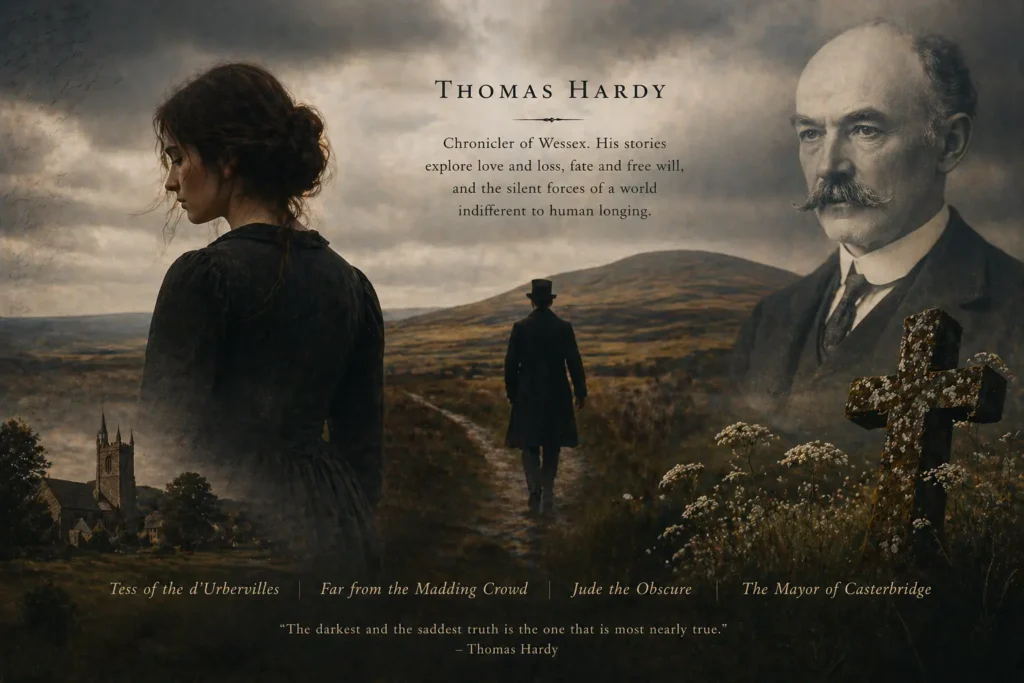
“Life is an oasis which is submerged in the swirling waves of sorrows and agonies.” ― Thomas Hardy, The Mayor of Casterbridge
Introduction:
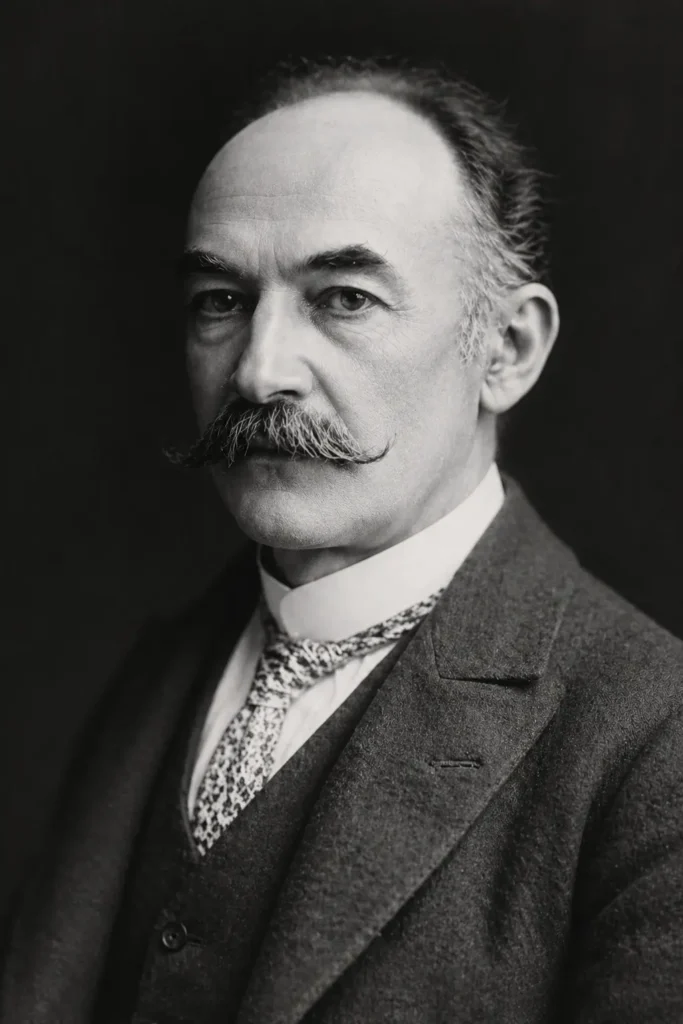
Thomas Hardy, the Victorian novelist and poet, was deeply influenced by Romanticism. His works challenged the conventionalities of his time and transgressed the societal norms by diving deeply in the realities of the hypocrisy of the society.
Style:
Seen through the prism of literary genres his work can be viewed in terms of boundaries, frames and horizons, most particularly horizons of expectations. Kramer comments on Hardy that, “He uses an experimental literary approach in The Mayor of Casterbridge, for example, in which established codes are revised, resulting in interstices between the new and old generic order. Later, he succeeds in reviving worn-out forms by pouring ‘new wine into old bottles’ (Jude, 180), demonstrating that the novel form of the fin-de-siècle period was inappropriate for radical writing.”
If the author wants his story to move in a particular key, he must strike the keynote right away and Thomas Hardy has an extraordinary genius for striking this keynote. For books conceived in this aesthetic way, the end and the beginning are very important. In the first paragraph itself the mood of the book is decisively established and Hardy contrives to do this by various devices.
The curtain rises on The Mayor of Casterbridge to reveal a country roads stretching away into the distance and the weary figures of Henchard and his wife and child trudging along it. This road is an image of the bleak pilgrimage which is to be the subject of the story. The opening of Jude shows us a poor little Jude saying farewell to the schoolmaster who has given him the first glimpse of the finer life of the mind which he is to pursue so vainly in his mature life. The contrast between what Jude is born to and what his nature aspires to, on which the drama hinges, is stated in the very first chapter.
Thomas Hardy seizes every opportunity that his subjects afford for a poetic treatment; gets every ounce of picturesque value from the country life which is its subject– from its natural beauty or its historic traditions and associations and its romantic element.[1] The theme of Jude, is a conflict between a sensitive, passionate temperament, with a cruel, conventional world while that in The Mayor of Casterbridge is survival of fittest in this bleak world.
Portrayal of females:
“With his emphasis on love goes an emphasis on the part played by women in his human drama. To Hardy as to Byron, love was women’s whole existence. Indeed, he has what is, rightly or wrongly, called ‘the old-fashioned view of women’. He stresses their frailty, their sweetness, their submissiveness, their coquetry, their caprice. Even when they are at fault, he represents them with a tender chivalry.” quotes Cecil.
Both his maternal grandmother Betty and his mother, Jemima, were notable and purposeful women with vigorous and lively minds and from them Hardy drew his keen sensitivity and his tenacious intellectual curiosity. In all of his novels one can find his trademarks – an intelligent, frustrated heroine; encroaching modernity and tragedy in love.
In both the works, Mayor of Casterbridge and Jude, Thomas Hardy portrays a wide range of contrasting female characters; be it the smart and rational material minded women who make their own way in the society like Lucetta or Arabella, or the beautiful and naive tragic heroine driven by fate like Elizabeth-Jane or the strong-headed, convention breaking heroine Sue Bridehead. Hardy’s remarkable women characters and their description[2], mark their effect in the conscious of the reader.
Themes dealt with:
Both the books dealt with marriage, divorce and the hypocrisy of late Victorian attitudes towards women and were described by Thomas Hardy as novels ‘addressed by a man to men and women of full age’. More specifically, Jude the Obscure shows the anxieties brought about by the shift in population from a rural to a predominantly urban one.
In Jude the Obscure the class-ridden educational system of the day is challenged by the defeat of Jude’s earnest aspirations to knowledge, while conventional morality is affronted by the way in which the sympathetically presented Jude and Sue change partners, live together, and have children with little regard for the institution of marriage. Though technically belonging to the 19th century, these novels anticipate the 20th century in regard to the nature and treatment of their subject matter.
18th century rationalism had united with it the new romantic spirit of rebellion against convention, to make the fundamental basis of belief-religious, social, political- which the people of the old England had unquestioningly accepted. The mental atmosphere of reflective minds tended to be overcast by clouds of doubts.
The parallels between the plot of Jude and Hardy’s own personal life are multiple. To begin with, there is the working-class man whose academic ambitions are thwarted and an unhappy relationship with a woman who went from sceptical to religious while he moved in the opposite direction.
There are plenty more, but Thomas Hardy seems to have strenuously denied the links to his own life, despite it being quite clear to see. Its apparent attack on the institution of marriage caused strain on Hardy’s already difficult marriage because Emma Hardy was concerned that Jude the Obscure would be read as autobiographical.Jude the Obscure, met with a very strong negative response from the Victorian public because of its controversial treatment of sex, religion and marriage.[3]
“This idea of the new man of the future haunted his imagination. It comes into several of his poems and finds its most extreme embodiment in the queen figure of Jude’s illegitimate child, Little Father Time… the little boy who was born already disillusioned with the world in which he found himself. ‘I should like the flowers very much’ he says, ‘if I did not keep on thinking they would all be withered in a few days.’” highlights Cecil.
Natural and Supernatural in Hardy:
Thomas Hardy embodies fate in various forms. Sometimes it appears in natural force, as Henchard’s plan for making himself rich are brought to naught by bad harvest; the weather takes the part of fate here. Sometimes it embodies itself as some innate weakness of character. Jude’s life is ruined because he has been endowed at birth, through no wish of his own, with an intensity of sexual temperament which he cannot control and which is his undoing or as Sue considers her downfall as a supernatural punishment. Chiefly, however, the forces of fate in Hardy’s novels incarnate themselves into two guises, as chance and as love.
His inclination towards the countryside and life of Wessex was reflected in his works. The man-nature relationship remains very indifferent to the man of his writings. In fact, Hardy’s tragic vision is a part of his pessimism. The role of fate is too prominent in his works. Thomas Hardy frequently conceived of, and wrote about, supernatural forces, particularly those that control the universe through indifference or caprice, a force he called The Immanent Will.
Conclusion:
“If a book is a work of art in so far as the imagination inspiring and it has transfigured the author’s experience, no novels are more aesthetic than Hardy’s. He never presents us with a mere record of his observation; always it is observation coloured by the idiosyncrasy of the artist’s personality, vitalized by the energy of the artist’s temperament. Hardy’s books are always pictures, and never photographs; and we like them as we like pictures– for aesthetic reasons: not only because the recall reality to us but because they stir our emotions directly by their own individual quality.” comments Cecil.
Considered a Victorian realist, Thomas Hardy examines the social constraints on the lives of those living in Victorian England and criticises those beliefs, especially those relating to marriage, education and religion that limited people’s lives and caused unhappiness. Thus is portrayed in his novels, the intensity of variety of style, philosophies and his genius as we noted in both the books written in different period through his life.
Jude the Obscure was Thomas Hardy’s final novel and is a far darker and more provocative novel from Hardy, inviting scandal for its attacks on social and religious conventions.[4] The characters of Jude and Sue are built up mot merely against the background of the huge and changing Wessex of the earlier novels, but out of it. It is this which makes the novel as critics say ‘the completion of an oeuvre’. Thus as Daiches says, “Hardy remains a novelist of unusual power and integrity, who added an epic dimension to the familiar realism of the Victorian novel.”
Stay tuned for next episodes as we decode further Literature tales and stories.
Meanwhile you can read the first episode of Shakespeare Simplified & Storified on ‘The Witches in William Shakespeare’s Macbeth‘.
[1] Cecil says, “It sets out, to give only a real but realistic picture of life. Hardy’s tender heart, stirred by the sufferings of working men with intellectual aspirations and uncomfortably warm sexual temperaments, wished to write a book bringing home the suffering to others. And he is therefore at pains to give an accurate presentation of such a life, but his imagination is not a realistic one.”
[2] For instance in a scene Jude described Sue as: “I cannot bear it – I cannot! I can’t answer her arguments – she has read ten times as much as I. Her intellect sparkles like diamonds, while mine smoulders like brown paper… She’s one too many for me!”
[3] Some booksellers sold the novel in brown paper bags, and Walsham How, the Bishop of Wakefield, is reputed to have burnt his copy. In his postscript of 1912, Hardy humorously referred to this incident as part of the career of the book: “After these [hostile] verdicts from the press its next misfortune was to be burnt by a bishop – probably in his despair at not being able to burn me”. While some suggest that Hardy gave up writing novels following the harsh criticism of Jude the Obscure in 1896, the poet C. H. Sisson calls this “hypothesis” “superficial and absurd”.
[4] Although, as Dennis Taylor suggests in his introduction to this Penguin Classics edition, Hardy may have already decided to end his novel writing career and the controversy gave him a convenient excuse to do so.
Books cited:
- Albert, Edward. History of English Literature. India: Oxford UP, 1979. Print.
- Cecil, David. Hardy The Novelist: An Essay in Criticism. India: Lyall Book Depot, 1967. Print.
- Daiches, David. A Critical History of English Literature (Volume 2). India: Supernova Publishers, 2010. Print.
- Hardy, Thomas. The Mayor of Casterbridge. Britain: Penguin Books, 1896. Print.
- Hardy, Thomas. Jude The Obscure. Britain: Penguin Books,1896. Print.
- Kramer, Dale. A Cambridge Companion of Thomas Hardy.U.K.: Cambridge University Press, 1999. Print.