

Introduction
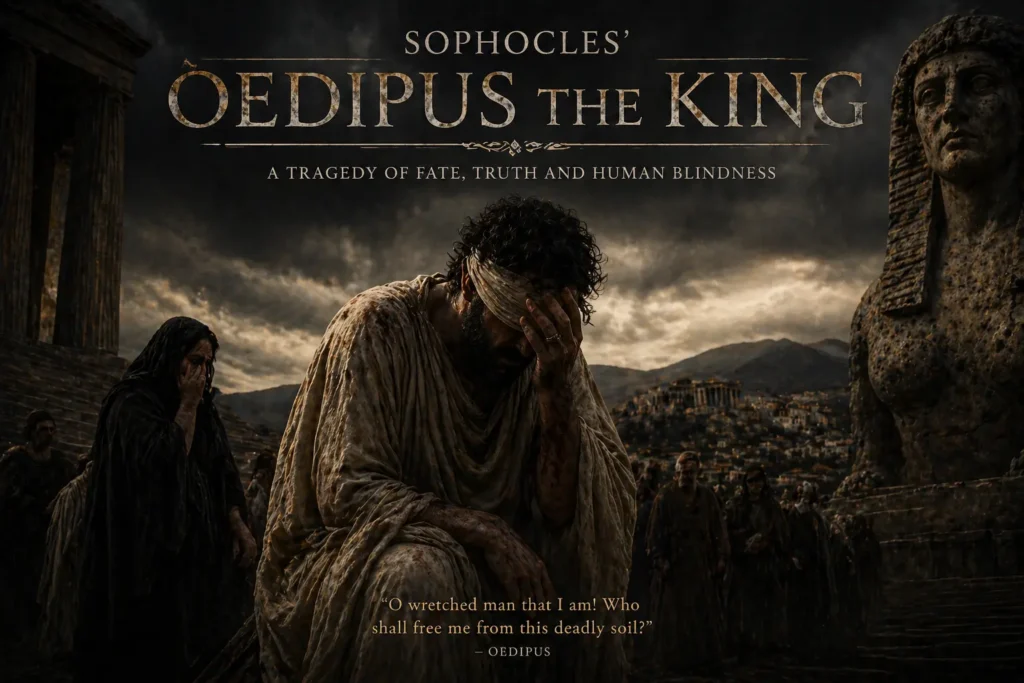
Oedipus is a Greek myth character, who is thought to have been originated in Mycenaean folklore. The character of Oedipus is also said to have appeared in the folk tradition of Albania, Finland and Cyprus. The story of Oedipus was initially cited by Homer and became a subject for a few post-Homeric epics, before becoming the central theme in 5th century tragedies, written for theatrical performances on the Festival of Dionysus.[[1]]
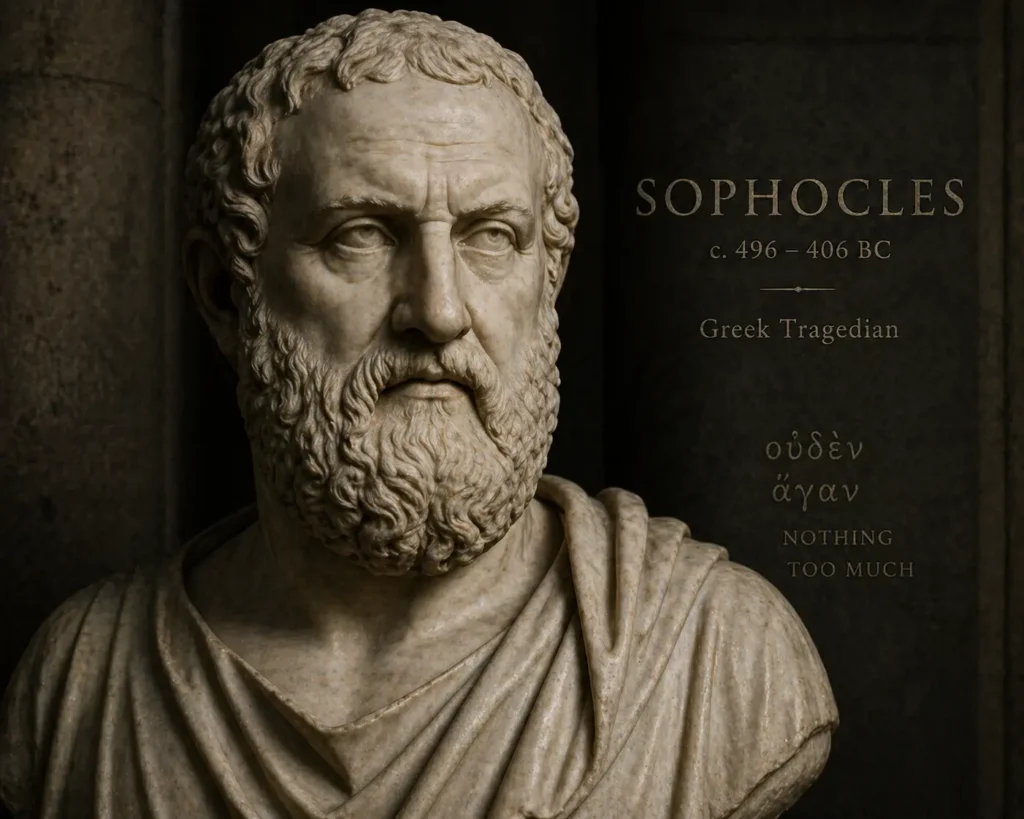
The legend of Oedipus has been retold in many versions. There are mentions of the myth in fragments by several ancient Greek poets including Homer, Hesiod and Pindar, in some lost epics of The Thebaid and Oedipodea and works of Aeschylus and Euripides. However, the most notable version of the legend comes from the three Theban plays by Sophocles, though the story differs by varying degrees from the original folklore or from the works of Aeschylus and Euripides.
Eliminating the Dramatising of the Mystic Elements by Sophocles.
Fowler says, ‘With very few exceptions, the subjects of Greek tragedy are mythical.’(182-183) Sophocles’ Oedipus the King briefly mentions of the tragic Greek myth story of Oedipus in the narration while the play emphasises on dramatising the repercussions of the oracle.[[2]] Aristotle insists that a play should have good reasons for beginning where it begins, for ending where it ends and that the incidents should follow from one another by a clear chain of causation without coincidence or irrelevance.
In Oedipus the King the beginning for example is when the plague occurs and Oedipus resolves to find its cause. The middle consists of his inquiry into the sad events surrounding the death of King Laius, which the oracle reveals is the root of the trouble. The end is when Oedipus finds the cause of the plague, i.e. himself. Aristotle says that well organised plots do not start and end anywhere but show a certain kind of order which is seen in Oedipus the King.
The play starts long after the oracle has been fulfilled, the main focus is on the current actions of Oedipus, his unconscious contributions to his downfall; hence making Oedipus the King a human tragedy, with no direct interventions by any supernatural force during the course of the play, although the Greek mythical elements are not totally discarded.[[3]]
Varied Versions of the Myth
The ancient story of Oedipus has intense dramatic appeal which attracted many writers to include the Greek myth in their works, at several phases and in various forms, thus creating divergent versions of the myth. In the post-Homeric works related to Oedipus, there are notable differences in emphasis and details. Borwa points out, ‘For Homer Oedipus’ rule in Thebes was due to the dire counsel of Gods. For Pindar the most significant element in the tale was the fulfilment of the oracle… For Aeschylus the whole tragedy followed a divine plan, and for Euripides fate determined Oedipus’ life from the beginning.
It was almost inevitable that any poet who told the story should stress both the magnitude of Oedipus’ fall and the part played in it by the gods.’(162-163) Sophocles as a playwright focused on the human component of the Greek myth, with a side-play of the mystic\oracle. Sophocles’ Oedipus represents two important themes of the Greek myth and drama, i.e. the flawed nature of mankind and their powerlessness against the law of fates and destiny. There is a marked difference between Aeschylus’ and Sophocles’ handling of the motif of Delphic oracle.
Difference between Sophocles’ Oedipus and other versions of the Greek myth
Homer related in his version that the investigation and discovery of the murderer occurred almost immediately instead of the long process of hunt in Sophocles, Homer’s Oedipus continued to rule at Thebes until his death which contradicts the banishment of Sophocles’ Oedipus and an inclusive detail in Homer that an another wife bore Oedipus’ children after Jocasta’s suicide, is never mentioned in Sophocles’ version.[[4]]
Aeschylus in Laius, gave a hint that Oedipus’ difficulties may be traced back to a curse laid on the family, when Laius raped the son of his host Pelops, thus dooming his own family while an oracle forbade him to beget any child lest it would be the reason of his death. Hence, giving a new horizon to the Greek myth that Oedipus’ fate was the result of a family curse instead of his own hamartia.
The sources of Sophocles’ version of the legendary Greek myth are thought to include Book XI of Homer’s Odyssey, two epic poems entitled Oedipodea and Thebais and four plays by Aeschylus including Seven Against Thebes.
Divine Intervention in Sophocles’ Oedipus
Quoting Bowra, ‘Sophocles allows no doubts, no criticism of the gods, sometimes indeed they are hard to understand, but none the less man must assume that all is as it ought to be. If divine ways seem wrong, human ignorance is to blame. In the end the gods will be proved right. Even though Apollo prophesied Oedipus’ fate before his birth, Sophocles portrays, it was Oedipus’ ignorance, his curiosity, his hamartia that led to his downfall.
Aristotle points that the misfortunes of the hero should be to some extent deserved. The tragedy of a faultless man repels us, the undeserved sufferings of an innocent person could be too terrible for us to endure. The oracle creates panic and fear in the minds of Laius and Jocasta and later Oedipus who eventually themselves fulfil the oracle while trying to prevent it. Oedipus says:
‘Apollo, friends, Apollo–
he ordained my agonies—these, my pains on pains!
But the hand that struck my eyes was mine,
Mine alone—no one else—
I did it all myself!’ (1467-1471)
where he blames Apollo for his destined pains and sufferings in front of the Theban crowd while admitting his own role in causing only his physical pain. While the gods decided the fate of the tragic hero, announced it in the form of oracles, brought plagues, led to situations that would lead to the fulfilment of the oracle and not leaving an option of escaping his fate, Oedipus cannot be stated fully responsible for his downfall, without even consciously committing any sin, but the lack of an actual intervention by a supernatural force during the course of the play, portrays Oedipus as the culprit of his own fate.
Conclusion
The Greek myth of Oedipus has inspired various artists and thinkers since ancient times. The Roman philosopher Seneca wrote another tragedy named Oedipus, influencing English writers like John Dryden and French writers Voltaire and Pierre Corneille. For Sigmund Freud, the founder of psychoanalysis, the name Oedipus acquired a significance beyond that associated with its antiquity, he universalized a concept of psychoanalytic theory named The Oedipus Complex.[[5]]
Aristotle writing in his Poetics, defines tragedy as the imitation of an action that is serious, complete and of a certain magnitude… in the form of action, not of narration through pity and fear, effecting the proper purgation of emotions. To Aristotle, tragedy has its own pleasure. This pleasure is produced when the emotions of pity and fear that tragedy arouses, flows away from us, like the waste products of the body after purgation.
It is this that Aristotle calls ‘catharsis’ of emotions, which the audience rightly feels after hearing the story of Oedipus by Sophocles, hence rightly regarding Sophocles’ Trilogy as a masterpiece of Athenian drama. Thus, the Greek myth story, striking as it already is in its content, owing to the remarkable handling of the great playwright, becomes one of the most memorable tragedies, which, even after 2500 years, is performed and watched everywhere in the world, while admiring Oedipus’s agonies as the chorus of the play says “You are my great example, you, your life your destiny, Oedipus, man of misery—I count no man blest.”(1317-1319)
Stay tuned for next Greek myth episodes as we decode further Literature tales, stories and Greek myths.
Meanwhile you can read the first episode of Shakespeare Simplified & Storified on ‘The Witches in William Shakespeare’s Macbeth‘.
[1] The festival of Dionysus was the theatrical event of the year in 5th century Athens, where playwrights would compete to entertain the masses of Athenian citizens.
[2] In Greek myths an oracle was an answer given by a god to a question asked by a worshipper, usually in the form of a command, a prediction or a statement of fact.
[3] Mention of Delphic oracle[line number– 81-84,108-111, 16-170], mention of the Greek myth of Sphinx[line number—44-46,148-150, 445-452],mention of the oracle of Oedipus’ fate[line number—401, 413, 784-788, 871-875, 914-915, 944-946, 1090-1092]
[4] In Euripides’ lost version of the Greek myth, it appears that Antigone survives at the end of the play, while Sophocles’ Antigone hangs herself at the end.]
[5] The Oedipus Complex is a psychoanalytic theory, the desire for sexual involvement with the parent of the opposite sex and concomitant sense of rivalry with the parent of same sex, in a child’s psyche.
Books cited:
- Bowra, C.M. Sophoclean Tragedy. OUP. 1944.
- Fagles, Robert. Trans. Sophocles. The Three Theban Plays. Penguin Books. 1982.
- Fowler, Harold. N. A History of Ancient Greek Literature. D. Appleton and Company. 1902.
- Heath, Malcolm. Trans. Aristotle. Poetics. Penguin Books.1996.