

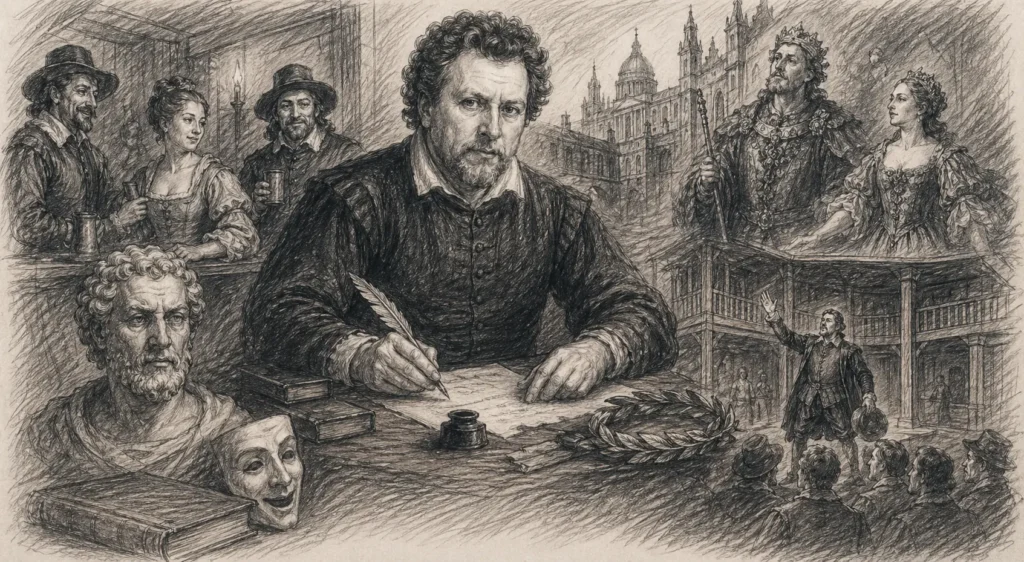
Introduction:
“The world is a comedy to those that think and a tragedy to those who feel”[[1]]
Satire is a genre of literature with its roots in Roman theatre that uses humour, irony, exaggeration, ridicule, understatement and sarcasm to explore and criticize people’s follies or vices. A satirist looks around him in the society and sees those who blindly imitate the follies of mankind and instead of pitying the wrong and making a tragedy out of it, laughs at their absurdity and lack of sense and highlights them in his\her art.
Ben Jonson’s Satire:
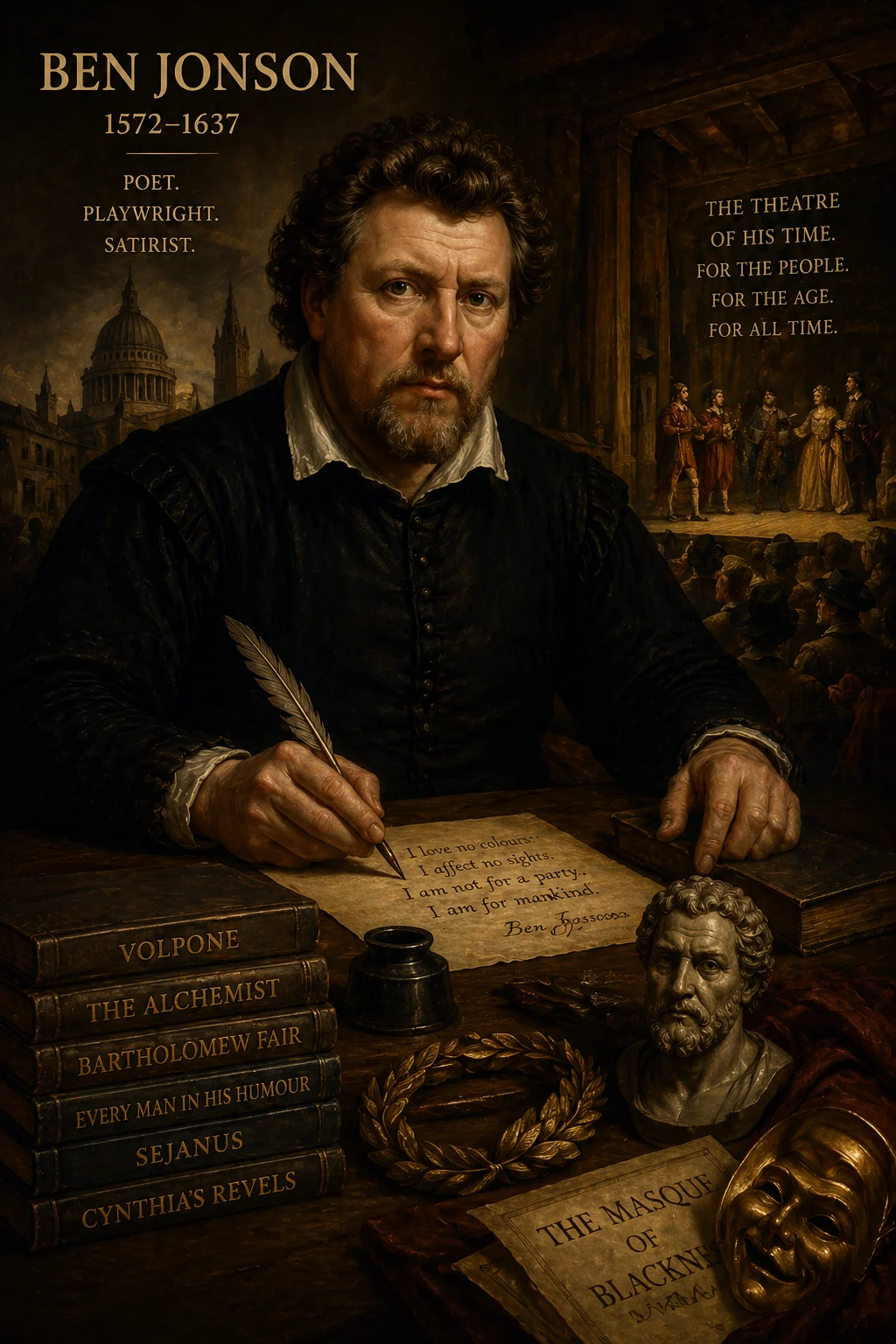
“Pedantic, imitative and supremely self-confident in his learned art, he (Jonson) is the one great example in English of the Renaissance Humanist turned dramatist and poet.”[[2]]
A great admirer of Bard and a prominent contemporary of Shakespeare; Ben Jonson was the most learned dramatist of his time and the master of theatrical plot, style and character, with technical skills, great wit and cynicism, considered as the perfect moral satirist. As a pioneer of neoclassic criticism, he chose to adhere to the theories of classical poetics. Jonson united two of the characteristic strength of Elizabethan drama, the native tradition of realism and classical insistence of form. Jonson was a master satirist whose comedies are both reformative and corrective.
The Satirical Twist of Jonson:
“There is a darkness that sometimes overspreads the human mind, which is more easily dissipated by the bright flashes of wit, than by the clear though steady light of reason.”[[1]]
Ben Jonson’s plays portray the contemporary London society; unravelling its hypocrisies, expressing a strong distaste for the immorality and all the negativity that had creeped in the society around him. Jonson as a satirist wanted his works to act as a medium for reforming the society, to chastise the vanities and caprices of men, with the sharp cutting edge of his comedies. He believed, if the audience laughed at their own follies there is a hope that public ridicule would make them restore to the righteousness. Hence, all his plays portray a guideline for a better ethical living.
Jonson as a literary critic satirist:
“If I would compare him (Jonson) with Shakespeare, I must acknowledge him the more correct poet, but Shakespeare the greater wit. Shakespeare was the Homer, or father of our dramatic poets; Jonson was the Virgil, the pattern of elaborate writing; I admire him, but I love Shakespeare.”[[2]]
Jonson was a complete antithesis of Shakespeare. Jonson upheld realism as opposed to romanticism, whereas Shakespeare stood for romantic views of things. Jonson as great classical scholar, confined strictly to the rules of classical drama in his comedies. He aimed to return to the controlled, satirical, realistic comedy of the classical literature.
Jonson took Aristotle’s analogyon tragedy[[3]] with same attitude towards comedy and asserted that the purpose of comedy was to purge mankind of his foibles and weaknesses. He was in revolt against the artistic principles of his contemporaries, the use of extra variant expressions and determined himself as a reformer of the Elizabethan stage. Jonson was engaged in the ‘War of the theatres’ or ‘Poetomachia’ between 1599 and 1602 in which he battled John Marston and Thomas Dekker by satirizing one another in their plays and poetry.
Jonson’s Comedy of Humours:
Concept of Humours:
Ben Jonson popularised the ‘Comedy of Humours’, which is a genre of satirical comedy based on the classical concept of humour.[[4]] Jonson distinguished two kinds of humour: one was true humour, in which one peculiar trait or disposition actually possessed a man, body, and soul; the other was adopted humour in which a man went out of his way to appear singular by affecting certain fashions of clothing, speech or social habits.
His double purpose of realism and satire led him to develop the device of humours. The word ‘humour’ had come to be used very carelessly during the Renaissance period; other playwrights treated the word as a whim or an eccentricity. In the prologue of ‘Every Man Out of His Humour’, Jonson asserts that his purpose is
“To give these ignorant well-spoken days some taste of their abuse of this word humour… Daily to see how the poor innocent word is rack’d and tortured.”[[5]]
The function of comedy of humours was to improve the human follies by holding them up to ridicule.
Elements of Comedy of Humours:
Each character of Comedy of Humours is seen to be dominated or even obsessed by a particular trait. Jonson preferred to treat his characters as abstract types derived from Greek and Roman models. Jonson is often seen to ridicule excessively, certain characters like that of the puritans, the parasite or the intellectual well read women.[[6]]
His characters have tag names like Brainworm, Wellbred, Lovewit etc, to identify their traits immediately and to disclose the humours to be exhibited by them. A display of emotions like greed, lust, jealously, ambition etc are vividly portrayed by the characters with liveliness of comic extravagance and absurdity.
Contributions of Ben Jonson:
Every Man in His Humour (1598) is considered an epoch making play which established Jonson’s reputation as a dramatist. Much of the dialogues are in prose. The play is full of vivacity, comedy of intrigue and cool irony. Every Man Out of His Humour (1599) is a sequel to the first play, which concentrates in greater single-mindedness and the illustration of ridiculous ‘humours’, with long-winded, didactic and over-charged satirical criticism.[[7]] Cynthia’s Revels (1600) completes the trio of the above mentioned plays. Its song “Queen and Huntress” was highly appreciated. The play introduced masques and was first acted by the boys of the Queen’s Chapel.[[8]]
Volpone(1607) portrays the humour of greed, vigorous use of blank verse in the play shows Jonson at his best. Jonson adopts the framework of a ‘beast fable’ where humans are caricatured by presenting them as animals. In the play Jonson is not ‘spotting with human follies’ but with crime. Dryden, in An Essay of Dramatic Poesy, provided a model analysis of the play Epicene, or the Silent Women(1609) saying, “I will take the pattern of a perfect play from Ben Jonson, who was a careful and learned observer of the dramatic laws.”
The play being less intent on moral castigation is therefore more agreeable. The Alchemist (1610) was set during the plague of 1610. It includes different kinds of characters, portraying a great variety of human weaknesses and follies. The entire play is blank verse, with rapid dialogues. Bartholomew Fair (1614), reveals the hypocrisy behind the facade of respectability that people project. It represents the other side of London where the lower classes gather at a fair. Full of life, colour, bustle, disorder and boisterous high spirit, we see a bright picture of the London society.[[9]]
Jonson’s later comedies like The Devil is an Ass (1616), The Staple of News(1625), The New Inn(1629), The Magnetic Lady(1632) and A Tale of Tub(1633), all show great variations but none amongst them is of the quality of his best mature comedies, hence Dryden regards them as the decline of Jonson. Jonson left unfinished a pastoral drama The Sad Shepherd or A Tale of Robin Hood.
In a Nutshell:
Ben Jonson’s works blend respect for Roman culture and literature and the traditional virtues of English society. The devoted classicist created satires that avenged individual follies, judged the puritans, marked and emphasized the societal hypocrisies and acted as a guide to his contemporaries to embrace classism. Various other works of literature mirror Jonson’s theory of ‘humour’ like Shakespeare’s The Merry Wives of Windsor, Chapman’s An Humorous Day’s Mirth, Day’s Humour Out of Breath and an anonymous play called Every Woman in Her Humour etc.
The glorious age of Comedy of Humours ended with Jonson and some of his contemporaries. Jonson died just at the beginning of his fame as a playwright and become more or less of an idol to the lesser dramatists who imitated him. He was buried in Westminster Abbey with an epithet,
“O rare Ben Jonson!”[[10]]
Stay tuned for next episodes as we decode further Literature tales and stories.
Meanwhile you can read the first episode of Shakespeare Simplified & Storified on ‘The Witches in William Shakespeare’s Macbeth‘.
Books\ Essays cited:
- Abbot, C., Lord Tenterden. On the Use and Abuse of Satire. Web
- Albert, Edward. History of English Literature. India: Oxford UP, 1997. Print.
- Daiches David. A Critical History of English Literature(Volume1). India: Supernova Publishers, 2010. Print.
- Dryden, John. Essay of Dramatick Poesie. London: Oxford UP. Web.
- Dutton, Richard. Ben Jonson Authority Criticism. Macmillan Ltd., 1996. Web.
[1] “One the Use and Abuse of Satire” by C. Abbot, Lord Tenterden, in “The Oxford Englidh Prize Essays.” Vol 1. p.193.
[2] David Daiches in “A Critical History of English Literature”, p.310
[3] In Aristotle’ Poetics, he says, tragedy has its own pleasure. This pleasure is produced when the emotions of pity and fear that tragedy arouses, flows away from us, like the waste products of the body after purgation. It is this that Aristotle calls ‘catharsis’ of emotions.
[4] The conception came originally from the mediaeval medicine, according to which a human body consisted of four fluids or humours which controlled human health and emotions; choler made the person ill tempered or angry whereas bile made him melancholic, while phlegm makes him slow or sluggish and blood makes him sanguine or optimistic. An imbalance of these fluids, led to a predominance of the particular quirk related to the humour in the person’s behaviour.
[5] “Every Man out of His Humours” (Everyman edition of Jonson’s plays. Vol1). p.62
[6] Jonson ridiculed the puritans for their looks, cant terms and hypocrisies in ‘The Alchemist’; he presented the character of a parasite as one who exploits others, with his folly of extreme greed in ‘Volpone’ with the character of Mosca(the fly) and he considered the attempt of the ladies of his day to appear intellectual as extremely ridiculous in ‘The Silent Woman’.
[7] “Jonson himself is introduced as Asper, explaining and commenting on the action in conversation with his friends Cordatus and Mitis. The latter two act as a sort of Chorus.” says Daiches in “A Critical History of English Literature.” P.314
[8] “It was typical of Jonson that he should have concluded the play with an Epilogue in which he aggressively asserted: ‘By God, ‘tis good, and if you like’t you may.’” commented Daiches in “A Critical History of English Literature.” P.314
[9] Unlike Volpone, here indeed Jonson ‘sports with human follies not with crimes’.
[10] It is claimed that the inscription could be read “Orare Ben Jonson”(pray for Ben Jonson), possibly an allusion to Jonson’s acceptance of Catholic church during his lifetime(although he had returned to the Church of England) but the carving shows a distinct space between “O” and “rare”.
[1] Horace Walpone in a letter to Sir Horace Mann. 1770.
[2] David Daiches in “A Critical History of English Literature”, p.309.