

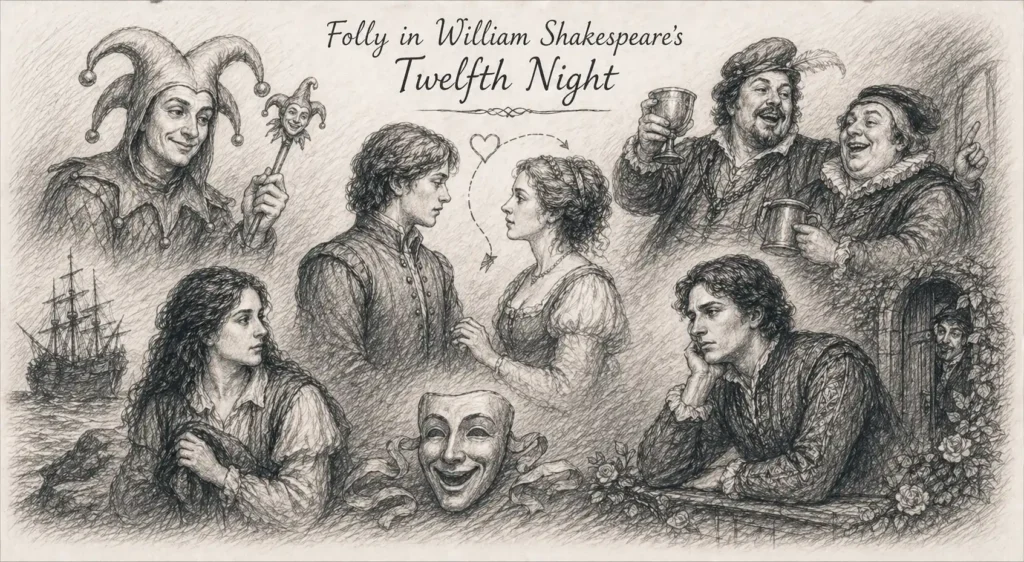
Folly in William Shakespeare’s Twelfth Night
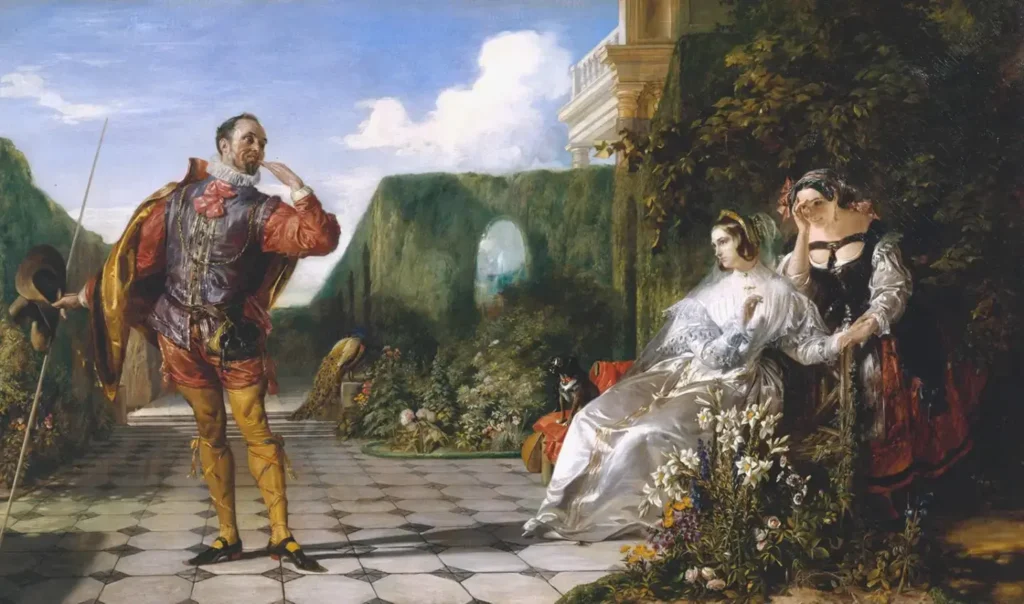
Image taken from Wikipedia.
Shakespearean critic Harold Bloom calls Twelfth Night “the greatest of all Shakespeare’s pure comedies.”(Bloom, 226). And indeed, the play depicts a healthy balance of wit, humour and romance. Fools, jesters, clowns, comedians, jokers and buffoons all entertain and provoke laughter which is the most important element of comedy since it manifests enaction of the critical. They act and respond in most distinctive manner to situations which sometimes are considered witty and at other instances foolish. Folly is the outcome of confused and delusional perspective concomitant of distorted nature and in some degrees present in everyman. As Feste suggests:
“Foolery, sir, does walk about the orb like the sun- it shines everywhere” (3.1.39-40).
In Twelfth Night the audience is exposed to a broad spectrum of fools. They range from aristocratic law-givers to the humble nitwit awkwardly blundering in refined society; from witty knights to accomplished professionals who develop individual sense of logic to such an extent that it distorts their instinctive perspective.
The polarities of wisdom and folly in Twelfth Night:
Feste, the allowed or professional fool is paradoxically the wisest of all as pointed out by Viola when she says:
“This fellow is wise enough to play the Fool,
And to do that well craves a kind of wit.” (3.1.61-62)
whereas Sir Andrew Aguecheek, the prodigal knight who has come to woo Olivia qualifies to be the natural fool about whose traits we hear even before he enters the stage when Maria declares:
“…for besides that he’s a fool, he’s a great quarreller; and but that he hath the gift of a coward to allay the gust he hath in quarrelling, ‘tis thought among the prudent he would quickly have the gift of grave.”(1.3.29-33)
Many critical assessments of Twelfth Night have tended to focus on the drama’s captivating characters as well as on the theme of folly like Bradly talks of Feste as:
“he(Feste) possesses not only the ready wit required by his profession, and an intellectual agility greater than it requires, but also an insight into character and into practical situations so swift and sure that he seems to supply, in fuller measure than any of Shakespeare’s other Fools, the poet’s own comment on the story”(Bradly,63)
while Daiches refers Sir Andrew Aguecheek as:
“There is no finer fool in literature than Sir Andrew Aguecheek” (Daiches, 259)
Feste constantly acts foolishly as his job is to offer solace and entertain his fellow mates; he often outsmarts the other characters in the play using his quick wits. He is quite an expert with words which is portrayed when he replies to Maria’s threat in Act I Scene v as:
“Let her hang me: he that is well hanged in this world needs to fear no colours.”(1.5.5-6)
Sir Andrew Aguecheek on the other hand when faced by Maria’s wit fails to hide his lack of language skills as he kept asking the meaning of different words. According to Sir Toby, Sir Andrew Aguecheek could play music and speak three or four languages; though this rumour is quickly put to rest. (He can speak a few words of French, though.) He himself claims he wishes he had spent more time studying foreign languages and less time fooling around. Maria mocks him without Aguecheek realizing what’s happening:
Andrew. Fair lady, do you think you have fools in hand?
Maria: Sir, I have not you by th’ hand.
Andrew. Marry, but you shall have, and here’s my hand. (1.3.63-67)
By taking his hand, Maria proves Andrew a “fool” and he merrily thinks she was being polite to him.
Feste on the one hand is an earner on his own talents, we do hear him appealing few times to double his tip; but this act of his is quite justifiable because he deserves better for his sharp wit. Feste is sensitive of his profession, always aware of the circumstances he is in whereas Sir Andrew Aguecheek the prodigal knight as reported by Maria who does not possess a penny for which he had worked for and has only inherited all his wealth. That too he seems to throw away to Sir Toby without realising.
Though Feste is often called the ‘fool’, he is well aware of his capabilities and talents and is proud of them which we notice when he answers to Cesario’s question whether he was Olivia’s fool as:
“I am indeed not her fool, but her corrupter of words.”(3.1.36-37)
On the other hand we see Sir Andrew Aguecheek who is quite arrogant of his knighthood as he calls himself a true knight (2.3.54). Aguecheek is proud of the fact that he guesses correctly that Malvolio is talking about him when Malvolio refers to a “foolish knight.” Aguecheek knows enough to recognize when he’s being ridiculed but he isn’t smart enough to be mad at the insult.
Malvolio: ‘Besides, you waste the treasure of your time with a foolish knight—’
Andrew, aside: That’s me, I warrant you.
Malvolio: ‘One Sir Andrew.’
Andrew, aside: I knew ’twas I, for many do call me fool. (2.5.77-82)
With Feste’s help, we are able to attain a better understanding of the other characters in the play as they reveal their true personalities. He deftly shows Olivia why she, not him, is irrational in her love for a dead brother. He notes that Olivia is foolish for wasting her youth and beauty by prolonging her mourning over her brother, especially when she believes his soul to be in heaven. He shows Olivia how unrealistic and excessive her mourning has been. He notes Duke Orsino’s extreme moodiness when he compares Orsino’s mind to an “opal” that changes colour.
When Feste says Orsino ought to wear a “taffeta” doublet, he gives voice to the idea that Orsino is moody, fickle, and silly and has been made “melancholy” by the Duke’s obsession with love. Feste is honest about his views and brave enough to confess his thoughts in front of Olivia and Orsino although he is well aware what the consequences can be if his comments are not taken in a good way by them.
This shows he is wise enough to know his limits while Sir Andrew Aguecheek when encouraged by Sir Toby for a duel with Cesario, he gets into the role foolishly but immediately backs down. His cowardly nature becomes evident when he becomes petrified of fighting Cesario following Sir Toby’s (false) reports of Cesario’s skill with a sword when he thinks Cesario is ready to put him down.
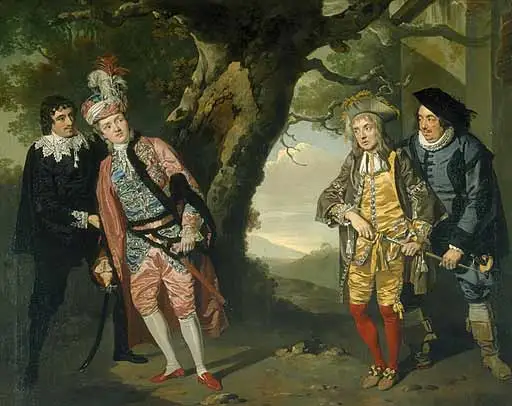
Image taken from Wikipedia
Feste seems wise enough to know the people around him also how they affect him when he tells Orsino that:
“Truly, sir, the better for my foes, and the worse for my friends.”(5.1.11-12)
which confuses Orsino and he tries to correct Feste to which he explains that his friends praise him and make him look like an idiot while his foes straightaway tell him that he is an idiot and helps him to understand himself better and advantage him for his betterment. Sir Andrew Aguecheek is unaware of his own friends fooling and plundering his wealth. Sir Toby Belch and Maria manipulate him throughout the play and often talk negatively about his character. Not only this, Andrew even opts to follow all the foolish advices provided by them including challenging Cesario for a duel but is left in bewilderment after Sir Toby abuses him in front of everyone in Act V Scene i.
“Well, God give them wisdom that have it; and those that are fools, let them use their talents.”(1.5.14-15)
quotes Feste where he implies that smart people who think they’re witty often turn out to be fools, but since he already is a fool he has got his talents of wit to support him, on the contrary Sir Andrew keeps desperately copying Sir Toby to prevent sounding like a fool in front of others in act II scene v and is seen noting Cesario’s word for later use to impress Olivia in act III scene v which shows that Sir Andrew belittles himself of his own wits.
One of Feste’s functions is to illustrate the merry, festive themes of Twelfth Night that are associated with the play’s title. The play’s title refers to the holiday celebrated on the twelfth day after Christmas known as Epiphany. Hence, Feste’s name is a derivative of the word festival.
Act II scene iii seems perfect to denote the feeling of festivity when Sir Toby, Sir Andrew and Feste gather and sing in the midst of night. When Feste enters Sir Andrew announces:
“Here comes the fool, i’ faith.”(2.3.14)
Well here we have the pot calling the kettle black. We see Sir Andrew praising Feste’s words as “this is the best fooling”(2.3.30) when all he is saying is meaningless blabber making it evident that Feste’s foolery is far beyond his understanding but he enjoys a good love song. In the past, he was once adored by someone. His mention of this may be a moment of realization, or a boast. Feste sings his first song upon Sir Toby and Sir Andrews requests for a love song. The first verse appears to be about Olivia, which demonstrates Feste’s keen perception of other characters,
“O Mistress mine, where are you roaming?
O, stay and hear! Your true love’s coming,”(2.3.40-41)
This shows Feste’s knowledge of Olivia’s roaming heart, searching for its true love. This next line perfectly foreshadows future events, as Olivia finds love not whilst searching for it, but by love finding her in the form of Sebastian.

Image credit: Folger Theatre Production
Though in the gulling of Malvolio, many others were involved with him but Feste seems to be the only person guilty of his mistake and helps Malvolio not only with light and paper but also delivers his letter to Olivia. Lois Potter says to this:
“Feste showed weary self-disgust as he removed his priest’s disguise, and compassion as he agreed to bring pen and ink to the prisoner.”(Potter, 68)
On the contrary Sir Andrew Aguecheek the sort of blame-shift he is, not only fails to own his fault after he hits Sebastian but also demands for justice after being hit back in return as he declares:
“I’ll have an action of battery against him, if there be any law in Illyria; though I struck him first, yet it’s no matter for that. “(4.1.33-35)
Although Sir Andrew Aguecheek is the dumbest of all the characters and misses out understanding most of the wit and the pranks being played but he can be justified because he has never had the privilege of the kind of lives the other characters have experienced not because of economic reasons, of course, but because he has not been a part of the culture of Illyria and specially because the Renaissance education was not available to him and hence he takes everything superficially whereas Feste being a part of Illyria since long, functions as the play’s wise observer, and as a wise observer, he also illustrates the theme of foolish human nature.
Feste is characterized as both a witty and wise person. Shakespeare presents the role of Feste as a paradox: the wisest character of the play is the paid fool. Throughout Twelfth Night Feste entertains and criticizes the other characters through his songs and witty wordplay, and at the same time makes them reflect on their current circumstances. Although he acts like a clown through most of the play, he is probably one of the most sensible and wise characters in the play as he is the speaker of many significant and deep meant words like:
“…As there is no true cuckold but calamity…” (1.5.49)
By which Feste means that calamity is a cuckold because no one can stay married to it forever, eventually all the grievances of life will someday disappear and one will have to get on with life. Feste also suggests Malvolio:
“I say there is no darkness but ignorance” (4.2.43-44)
who was complaining of the darkness of room where had been captured. Feste knows it is dark in there but still chooses to confuse Malvolio by saying words that do indicate the darkness clearly but Malvolio is too occupied with frustration to notice. Here Feste is comparing ignorance to darkness and knowledge to light. With knowledge one’s understanding of the world deepens as though better lit but in ignorance one cannot fully sense the world around him like Malvolio who himself is ignorant and blinded by his love for Olivia, and wouldn’t fully understand the metaphor.
“Nothing that is so, is so.”(4.1.8-9)
Feste says so ironically, talking to Sebastian, who he is convinced is actually Cesario. This is said for a specific situation, but it might actually be relevant for the whole play regarding everything absurd that takes place in Illyria. It highlights the paradox between appearance and reality in Twelfth Night.
In a Nutshell:
Feste quotes an antimetabole by his imaginary mentor, Quinopalus:
“Better a witty fool than a foolish wit.”(1.5.34)
which indicates that it is better to be a person who claims himself to be a fool, yet speak and do things with wit, rather than to be one who claims to be a wit or intelligent man, and instead do and say foolish things. With Feste being the wisest (witty fool) among all the other characters, as a contrast to his job of foolery and Sir Andrew being the real fool (foolish wit), in spite of his honour and wealth we see the polarities of wisdom and folly on the same stage. The character of Feste is solitary wit surrounded by fools like the knighthood masked Sir Andrew Aguecheek who proves to be the natural fool of the play.
Stay tuned for next episodes as we decode further Literature tales and stories.
Meanwhile you can read the first episode on ‘The Witches in William Shakespeare’s Macbeth‘.
Works Cited
Books:
Bloom, Harold. Shakespeare: The Invention of the Human. New York: Riverhead Books, 1998. (226). Print
Bradley, A.C. ‘Feste the Jester”. Shakespeare Twelfth Night A Casebook. London: The Macmillan Press Ltd., 1972. (63). Print.
Brown, John Russell. Shakespeare And His Comedies. London: Methuen & Co. Ltd., 1957. Print.
Daiches, David. A Critical History of English Literature (Volume 1). India: Supernova Publishers, 2010. (259). Print.
Lothian, J.M, and Craik, T.W. The Arden Edition of the Works of William Shakespeare Twelfth Night. London: Methuen & Co. Ltd., 1957.(iii) Print.
Potter, Lois. Twelfth Night Text and Performance. London: The Macmillan Press Ltd., 1985. (68). Print.
Pingback: Tragedy of the witches in Shakespeare's Macbeth, Ep.1
Pingback: Shakespeare's Sonnets: Riveting Portrayal of Women, Ep. 3